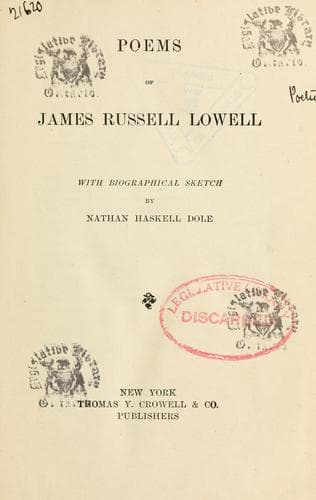
Poems of James Russell Lowell: With biographical sketch by Nathan Haskell DoleLowell, James Russell
General
Poems of James Russell Lowell: With biographical sketch by Nathan Haskell Dole
Lowell, James Russell
American poetry
[This letter of Mr. Sawin's was not originally written in
verse. Mr. Biglow, thinking it peculiarly susceptible of
metrical adornment, translated it, so to speak, into his own
vernacular tongue. This is not the time to consider the
question, whether rhyme be a mode of expression natural to
the human race. If leisure from other and more important
avocations be granted, I will handle the matter more at
large in an appendix to the present volume. In this place I
will barely remark, that I have sometimes noticed in the
unlanguaged prattlings of infants a fondness for
alliteration, assonance, and even rhyme, in which natural
predisposition we may trace the three degrees through which
our Anglo-Saxon verse rose to its culmination in the poetry
of Pope. I would not be understood as questioning in these
remarks that pious theory which supposes that children, if
left entirely to themselves, would naturally discourse in
Hebrew. For this the authority of one experiment is claimed,
and I could, with Sir Thomas Browne, desire its
establishment, inasmuch as the acquirement of that sacred
tongue would thereby be facilitated. I am aware that
Herodotus states the conclusion of Psammeticus to have been
in favor of a dialect of the Phrygian. But, beside the
chance that a trial of this importance would hardly be
blessed to a Pagan monarch whose only motive was curiosity,
we have on the Hebrew side the comparatively recent
investigation of James the Fourth of Scotland. I will add to
this prefatory remark, that Mr. Sawin, though a native of
Jaalam, has never been a stated attendant on the religious
exercises of my congregation. I consider my humble efforts
prospered in that not one of my sheep hath ever indued the
wolf's clothing of war, save for the comparatively innocent
diversion of a militia training. Not that my flock are
backward to undergo the hardships of _defensive_ warfare.
They serve cheerfully in the great army which fights even
unto death _pro aris et focis_, accoutred with the spade,
the axe, the plane, the sledge, the spelling-book, and other
such effectual weapons against want and ignorance and
unthrift. I have taught them (under God) to esteem our human
institutions as but tents of a night, to be stricken
whenever Truth puts the bugle to her lips and sounds a march
to the heights of wider-viewed intelligence and more perfect
organization.--H. W.]
Public-domain text, read in full here on John Shaqi.
Reviews
Reviews
No reviews yet
Be the first to share your thoughts on this work.
Elsewhere in the archive
Join the Discussion
Join the discussion
Sign in to leave a comment or review.
Sign InorCreate an account