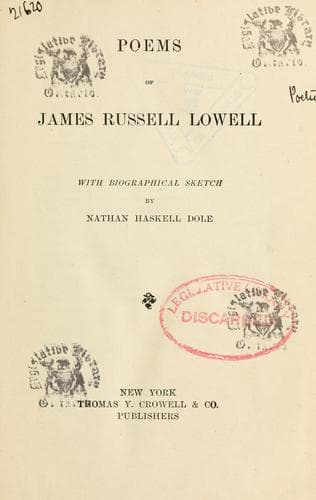
Poems of James Russell Lowell: With biographical sketch by Nathan Haskell DoleLowell, James Russell
General
Poems of James Russell Lowell: With biographical sketch by Nathan Haskell Dole
Lowell, James Russell
American poetry
[The attentive reader will doubtless have perceived in the
foregoing poem an allusion to that pernicious
sentiment,--"Our country, right or wrong." It is an abuse of
language to call a certain portion of land, much more,
certain personages, elevated for the time being to high
station, our country. I would not sever nor loosen a single
one of those ties by which we are united to the spot of our
birth, nor minish by a tittle the respect due to the
Magistrate. I love our own Bay State too well to do the one,
and as for the other, I have myself for nigh forty years
exercised, however unworthily, the function of Justice of
the Peace, having been called thereto by the unsolicited
kindness of that most excellent man and upright patriot,
Caleb Strong. _Patriæ fumus igne alieno luculentior_ is best
qualified with this,--_Ubi libertas, ibi patria_. We are
inhabitants of two worlds, and owe a double but not a
divided, allegiance. In virtue of our clay, this little ball
of earth exacts a certain loyalty of us, while, in our
capacity as spirits, we are admitted citizens of an
invisible and holier fatherland. There is a patriotism of
the soul whose claim absolves us from our other and terrene
fealty. Our true country is that ideal realm which we
represent to ourselves under the names of religion, duty,
and the like. Our terrestrial organizations are but far-off
approaches to so fair a model, and all they are verily
traitors who resist not any attempt to divert them from this
their original intendment. When, therefore, one would have
us to fling up our caps and shout with the multitude,--"_Our
country, however bounded!_" he demands of us that we
sacrifice the larger to the less, the higher to the lower,
and that we yield to the imaginary claims of a few acres of
soil our duty and privilege as liegemen of Truth. Our true
country is bounded on the north and the south, on the east
and the west, by Justice, and when she oversteps that
invisible boundary-line by so much as a hair's-breadth, she
ceases to be our mother, and chooses rather to be looked
upon _quasi noverca_. That is a hard choice, when our
earthly love of country calls upon us to tread one path and
our duty points us to another. We must make as noble and
becoming an election as did Penelope between Icarius and
Ulysses. Veiling our faces, we must take silently the hand
of Duty to follow her.
Shortly after the publication of the foregoing poem, there
appeared some comments upon it in one of the public prints
which seemed to call for animadversion. I accordingly
addressed to Mr. Buckingham, of the Boston Courier, the
following letter.
|Jaalam|, November 4, 1847.
_'To the Editor of the Courier:_
Public-domain text, read in full here on John Shaqi.
Reviews
Reviews
No reviews yet
Be the first to share your thoughts on this work.
Elsewhere in the archive
Join the Discussion
Join the discussion
Sign in to leave a comment or review.
Sign InorCreate an account