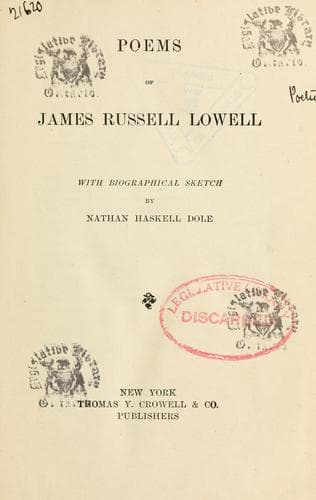
Poems of James Russell Lowell: With biographical sketch by Nathan Haskell DoleLowell, James Russell
General
Poems of James Russell Lowell: With biographical sketch by Nathan Haskell Dole
Lowell, James Russell
American poetry
"The productions of Mr. B. have been stigmatized in some
quarters as unpatriotic; but I can vouch that he loves his
native soil with that hearty, though discriminating,
attachment which springs from an intimate social intercourse
of many years' standing. In the ploughing season, no one has
a deeper share in the well-being of the country than he. If
Dean Swift were right in saying that he who makes two blades
of grass grow where one grew before confers a greater
benefit on the state than he who taketh a city, Mr. B. might
exhibit a fairer claim to the Presidency than General Scott
himself. I think that some of those disinterested lovers of
the hard-handed democracy, whose fingers have never touched
anything rougher than the dollars of our common country,
would hesitate to compare palms with him. It would do your
heart good, respected Sir, to see that young man mow. He
cuts a cleaner and wider swarth than any in this town.
"But it is time for me to be at my Post. It is very clear
that my young friend's shot has struck the lintel, for the
Post is shaken (Amos ix. 1). The editor of that paper is a
strenuous advocate of the Mexican war, and a colonel, as I
am given to understand. I presume, that, being necessarily
absent in Mexico, he has left his journal in some less
judicious hands. At any rate, the Post has been too swift on
this occasion. It could hardly have cited a more
incontrovertible line from any poem than that which it has
selected for animadversion, namely,--
'We kind o' thought Christ went agin war an' pillage.'
"If the Post maintains the converse of this proposition, it
can hardly be considered as a safe guide-post for the moral
and religious portions of its party, however many other
excellent qualities of a post it may be blessed with. There
is a sign in London on which is painted,--'The Green Man.'
It would do very well as a portrait of any individual who
would support so unscriptural a thesis. As regards the
language of the line in question, I am bold to say that He
who readeth the hearts of men will not account any dialect
unseemly which conveys a sound and pious sentiment. I could
wish that such sentiments were more common, however
uncouthly expressed. Saint Ambrose affirms, that _veritas a
quocunque_ (why not, then, _quomodocunque_?) _dicatur, a
spiritu sancto est_. Digest also this of Baxter:--'The
plainest words are the most profitable oratory in the
weightiest matters.'
Public-domain text, read in full here on John Shaqi.
Reviews
Reviews
No reviews yet
Be the first to share your thoughts on this work.
Elsewhere in the archive
Join the Discussion
Join the discussion
Sign in to leave a comment or review.
Sign InorCreate an account