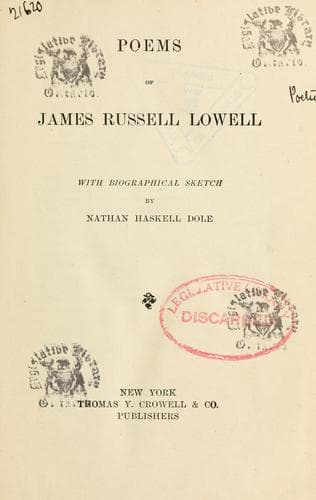
Poems of James Russell Lowell: With biographical sketch by Nathan Haskell DoleLowell, James Russell
General
Poems of James Russell Lowell: With biographical sketch by Nathan Haskell Dole
Lowell, James Russell
American poetry
"I know of no so responsible position as that of the public
journalist. The editor of our day bears the same relation to
his time that the clerk bore to the age before the invention
of printing. Indeed, the position which he holds is that
which the clergyman should hold even now. But the clergyman
chooses to walk off to the extreme edge of the world, and to
throw such seed as he has clear over into that darkness
which he calls the Next Life. As if _next_ did not mean
_nearest_, and as if any life were nearer than that
immediately present one which boils and eddies all around
him at the caucus, the ratification meeting, and the polls!
Who taught him to exhort men to prepare for eternity, as for
some future era of which the present forms no integral part?
The furrow which Time is even now turning runs through the
Everlasting, and in that must he plant, or nowhere. Yet he
would fain believe and teach that we are _going_ to have
more of eternity than we have now. This _going_ of his is
like that of the auctioneer, on which _gone_ follows before
we have made up our minds to bid,--in which manner, not
three months back, I lost an excellent copy of Chappelow on
Job. So it has come to pass that the preacher, instead of
being a living force, has faded into an emblematic figure at
christenings, weddings, and funerals. Or, if he exercise any
other function, it is as keeper and feeder of certain
theologic dogmas, which, when occasion offers, he unkennels
with a _staboy_! 'to bark and bite as 'tis their nature to,'
whence that reproach of _odium theologicum_ has arisen.
"Meanwhile, see what a pulpit the editor mounts daily,
sometimes with a congregation of fifty thousand within reach
of his voice, and never so much as a nodder, even, among
them! And from what a Bible can he choose his text,--a Bible
which needs no translation, and which no priestcraft can
shut and clasp from the laity,--the open volume of the
world, upon which, with a pen of sunshine or destroying
fire, the inspired Present is even now writing the annals of
God! Methinks the editor who should understand his calling,
and be equal thereto, would truly deserve that title of
ποιμὴν λαῶν, which Homer bestows upon princes. He would be
the Moses of our nineteenth century; and whereas the old
Sinai, silent now, is but a common mountain stared at by the
elegant tourist and crawled over by the hammering geologist,
he must find his tables of the new law here among factories
and cities in this Wilderness of Sin (Numbers xxxiii. 12)
called Progress of Civilization, and be the captain of our
Exodus into the Canaan of a truer social order.
Public-domain text, read in full here on John Shaqi.
Reviews
Reviews
No reviews yet
Be the first to share your thoughts on this work.
Elsewhere in the archive
Join the Discussion
Join the discussion
Sign in to leave a comment or review.
Sign InorCreate an account