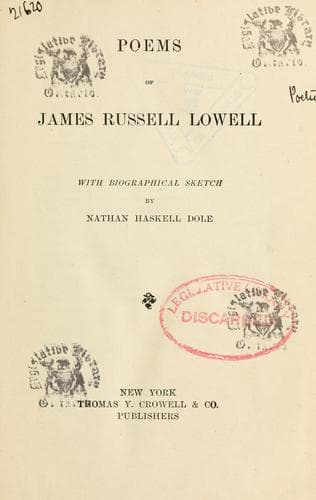
Poems of James Russell Lowell: With biographical sketch by Nathan Haskell DoleLowell, James Russell
General
Poems of James Russell Lowell: With biographical sketch by Nathan Haskell Dole
Lowell, James Russell
American poetry
How should she dream of ill? the heart filled quite
With sunshine, like the shepherd's-clock at noon,
Closes its leaves around its warm delight;
Whate'er in life is harsh or out of tune
Is all shut out, no boding shade of light
Can pierce the opiate ether of its swoon:
Love is but blind as thoughtful justice is,
But naught can be so wanton-blind as bliss.
XXXIII.
All beauty and all life he was to her;
She questioned not his love, she only knew
That she loved him, and not a pulse could stir
In her whole frame but quivered through and through
With this glad thought, and was a minister
To do him fealty and service true,
Like golden ripples hasting to the land
To wreck their freight of sunshine on the strand.
XXXIV.
O dewy dawn of love! O hopes that are
Hung high, like the cliff-swallow's perilous nest,
Most like to fall when fullest, and that jar
With every heavier billow! O unrest
Than balmiest deeps of quiet sweeter far!
How did ye triumph now in Margaret's breast,
Making it readier to shrink and start
Than quivering gold of the pond-lily's heart.
XXXV.
Here let us pause: O, would the soul might ever
Achieve its immortality in youth,
When nothing yet hath damped its high endeavor
After the starry energy of truth!
Here let us pause, and for a moment sever
This gleam of sunshine from the days unruth
That sometime come to all, for it is good
To lengthen to the last a sunny mood.
PART SECOND.
I.
As one who, from the sunshine and the green,
Enters the solid darkness of a cave,
Nor knows what precipice or pit unseen
May yawn before him with its sudden grave,
And, with hushed breath, doth often forward lean,
Dreaming he hears the plashing of a wave
Dimly below, or feels a damper air
From out some dreary chasm, he knows not where;--
II.
So, from the sunshine and the green of love,
We enter on our story's darker part;
And, though the horror of it well may move
An impulse of repugnance in the heart,
Yet let us think, that, as there's naught above
The all-embracing atmosphere of Art,
So also there is naught that falls below
Her generous reach, though grimed with guilt and woe.
III.
Her fittest triumph is to show that good
Lurks in the heart of evil evermore,
That love, though scorned, and outcast, and withstood,
Can without end forgive, and yet have store;
God's love and man's are of the self-same blood,
And He can see that always at the door
Of foulest hearts the angel-nature yet
Knocks to return and cancel all its debt.
IV.
Public-domain text, read in full here on John Shaqi.
Reviews
Reviews
No reviews yet
Be the first to share your thoughts on this work.
Elsewhere in the archive
Join the Discussion
Join the discussion
Sign in to leave a comment or review.
Sign InorCreate an account