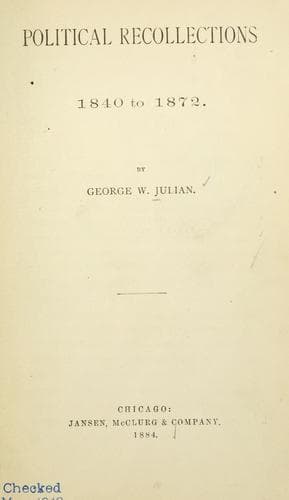
Political Recollections: 1840 to 1872Julian, George Washington
History
Political Recollections: 1840 to 1872
Julian, George Washington
Republican Party (U.S. : 1854- ) -- History; United States -- Politics and government
The canvass for Douglas was prosecuted with remarkable energy and
zeal. He was himself the great leader of his party on the stump,
and his efforts evinced singular courage, audacity, and will. It
soon became evident, however, that his election was impossible;
but this did not cool his ardor or relax his efforts. He kept up
the fight to the end; and after his defeat, and when he saw the
power that had destroyed him organizing its forces for the destruction
of the Union, he espoused the side of his country, and never faltered
in his course. But as to slavery he seemed to have no conscience,
regarding it as a matter of total moral indifference, and thus
completely confounding the distinction between right and wrong.
During the closing hours of his life he probably saw and lamented
this strange infatuation; and he must, at all events, have deplored
the obsequious and studied devotion of a life-time to the service
of a power which at last demanded both the sacrifice of his country
and himself. The canvass for Lincoln was conducted by the ablest
men in the party, and was marked by great earnestness and enthusiasm.
It was a repetition of the Fremont campaign, with the added difference
of a little more contrivance and spectacular display in its
demonstrations, as witnessed in the famous organization known as
the "Wide-Awakes." The doctrines of the Chicago platform were very
thoroughly discussed, and powerfully contributed to the further
political education of the people. The speeches of Mr. Seward were
singularly able, effective and inspiring, and he was the acknowledged
leader of his party and the idol of the Republican masses everywhere.
This was the day of his glory, and nothing yet foreshadowed the
political eclipse which awaited him in the near future. The triumph
of the Republicans in this struggle was not, however, final. A
great work yet remained to be done. A powerful anti-slavery party
had at last appeared, as the slow creation of events and the fruit
of patient toil and endeavor; but it had against it a popular
majority of nearly a million. Both Houses of Congress and the
Supreme Court of the United States disputed its authority and
opposed its advance. The President-elect could not form his cabinet
without the leave of the Senate, which was controlled by slavery,
nor could he set the machinery of his Administration in motion, at
home or abroad, through the exercise of his appointing power,
without the consent of his political opponents. As Mr. Seward
declared in the Senate, "he could not appoint a minister or even
a police agent, negotiate a treaty or procure the passage of a law,
and could hardly draw a musket from the public arsenal to defend
his own person." The champions of slavery had no dream of surrender,
and no excuse whatever for extreme measures; and with moderate
counsels and the prudent economy of their advantages, they were
the undoubted masters of their own fortunes for indefinite years
to come.
Public-domain text, read in full here on John Shaqi.
Reviews
Reviews
No reviews yet
Be the first to share your thoughts on this work.
Elsewhere in the archive
Join the Discussion
Join the discussion
Sign in to leave a comment or review.
Sign InorCreate an account