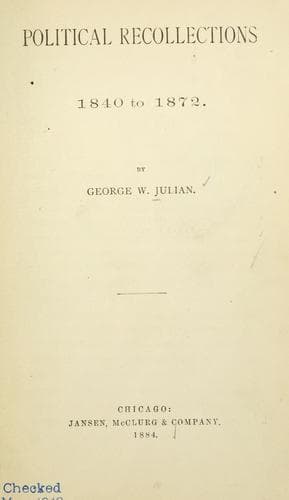
Political Recollections: 1840 to 1872Julian, George Washington
History
Political Recollections: 1840 to 1872
Julian, George Washington
Republican Party (U.S. : 1854- ) -- History; United States -- Politics and government
The closing months of Mr. Buchanan's Administration were dismal
and full of apprehension. One by one the slaveholding States were
seceding from the Union. The President, in repeated messages,
denied their right to secede, but denied also the right of the
Government to coerce them into obedience. It should be remembered,
to his credit, that he did insist upon the right to enforce the
execution of the laws in all the States, and earnestly urged upon
Congress the duty of arming him with the power to do this; but
Congress, much to its discredit, paid no attention to his wishes,
leaving the new Administration wholly unprepared for the impending
emergency, while strangely upbraiding the retiring President for
his non-action. For this there could be no valid excuse. The
people of the Northern States, now that the movement in the South
was seen to be something more than mere bluster, were equally
alarmed and bewildered. The "New York Herald" declared that
"coercion, if it were possible, is out of the question." The
"Albany Argus" condemned it as "madness." The "Albany Evening
Journal" and many other leading organs of Republicanism, East and
West, disowned it, and counseled conciliation and further concessions
to the demands of slavery. The "New York Tribune" emphatically
condemned the policy of coercion, and even after the cotton States
had formed their Confederacy and adopted a provisional Government,
it declared that "whenever it shall be clear that the great body
of the Southern people have become conclusively alienated from the
Union and anxious to escape from it, we will do our best to forward
their views." The "Tribune" had before declared that "whenever a
considerable section of our Union shall deliberately resolve to go
out, we shall resist all coercive measures designed to keep it in.
We hope never to live in a Republic whereof one section is pinned
to the other by bayonets." It is true, that it justified the
secession of the Southern States as a revolutionary right; but
although these States defended it as a constitutional one, the
broader and higher ground of Mr. Greeley necessarily gave powerful
aid and comfort to their movement. In the meantime, great meetings
in Philadelphia and New York strongly condemned the Abolitionists,
and urged the most extravagant additional concessions to slavery
for the sake of peace. On the 12th of January Mr. Seward made his
great speech in the Senate, declaring that he could "afford to meet
prejudice with conciliation, exaction with concession which surrenders
no principle, and violence with the right hand of peace." He was
willing to give up Congressional prohibition of slavery in the
Territories, enforce the Fugitive Slave law, and perpetuate slavery
in our Republic by amending the Constitution for that purpose.
The Crittenden compromise, which practically surrendered everything
to slavery, only failed in the Senate by one vote, and this failure
Public-domain text, read in full here on John Shaqi.
Reviews
Reviews
No reviews yet
Be the first to share your thoughts on this work.
Elsewhere in the archive
Join the Discussion
Join the discussion
Sign in to leave a comment or review.
Sign InorCreate an account