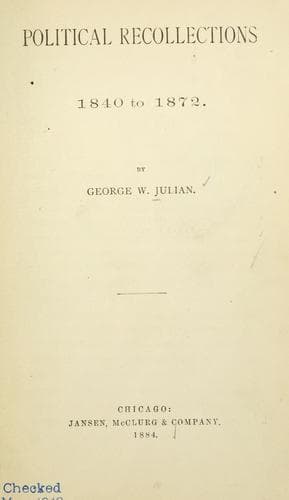
Political Recollections: 1840 to 1872Julian, George Washington
History
Political Recollections: 1840 to 1872
Julian, George Washington
Republican Party (U.S. : 1854- ) -- History; United States -- Politics and government
legislates," and the time had now come when nothing else could
break the spell of irresolution and blindness which threatened the
Union even more seriously than armed treason itself.
Notwithstanding this strange epoch of Republican feebleness and
indecision, the warfare against Mr. Buchanan was never intermitted.
It had been prosecuted with constantly increasing vigor since the
year 1856, and had now become so perfectly relentless and overwhelming
that he was totally submerged by the waves of popular wrath; and
for twenty odd years no political resurrection has been thought
possible. Although his personal integrity was as unquestionable
as that of John C. Calhoun or George III, and his private life as
stainless, yet his public character has received no quarter from
his enemies and but little defense from his friends. One of his
most formidable critics, writing long years after the war, describes
him as "hungry for regard, influence, and honor, but too diminutive
in intellect and character to feel the glow of true ambition--a
man made, so to speak, to be neither loved nor hated, esteemed nor
despised, slighted nor admired; intended to play an influential
part in the agitation of parties, and by history to be silently
numbered with the dead, because in all his doings there was not a
single deed; a man to whom fate could do nothing worse than place
him at the helm in an eventful period." While there is a measure
of truth in this picture, I believe any fair-minded man will
pronounce it over-drawn, one-sided, and unjust, after reading the
recently published life of Mr. Buchanan by George Ticknor Curtis,
dealing fully with his entire public career in the clear, cold
light of historic facts. The most pronounced political foe of Mr.
Buchanan can not go over the pages of this elaborate and long-delayed
defense without modifying some of his most decided opinions; but
one thing remains obviously true, and that is in dealing with the
question of slavery Mr. Buchanan was wholly without a conscience.
The thought seems never to have dawned upon him that the slave was
a man, and therefore entitled to his natural rights. In a public
speech on the ninth of July, 1860, defining his position, and
referring to the Dred Scott decision, he says: "It is to me the
most extraordinary thing in the world that this country should now
be distracted and divided because certain persons at the North will
not agree that their brethren at the South should have the same
rights in the Territories which they enjoy. What would I, as a
Pennsylvanian, say or do, supposing any one was to contend that the
Legislature of any Territory could outlaw iron or coal within the
Territory? The principle is precisely the same. The Supreme Court
of the United States has decided, what was known to us all to have
been the existing state of affairs for fifty years, that slaves
are property. Admit that fact, and you admit everything."
Public-domain text, read in full here on John Shaqi.
Reviews
Reviews
No reviews yet
Be the first to share your thoughts on this work.
Elsewhere in the archive
Join the Discussion
Join the discussion
Sign in to leave a comment or review.
Sign InorCreate an account