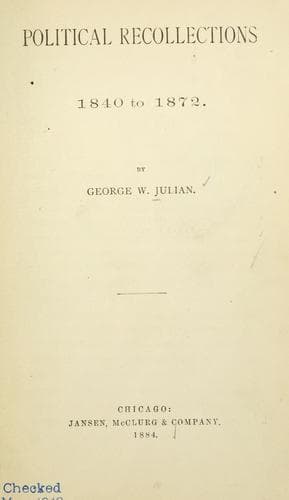
Political Recollections: 1840 to 1872Julian, George Washington
History
Political Recollections: 1840 to 1872
Julian, George Washington
Republican Party (U.S. : 1854- ) -- History; United States -- Politics and government
In the third place, under our new Indian treaty policy, invented
about the same time, large bodies of land, when released by our
Indian tribes, were sold at low rates to individual speculators
and monopolists, or to railway corporations, instead of being
conveyed, as before, to the United States, and thus subjected to
general disposition, as other public land. These evils are now
remedied, but for nearly ten years they were unchecked. The title
to Indian lands was secured through treaties concocted by a ring
of speculators and monopolists outside of the Senate, and frequently
ratified by that body near the close of a long session, when less
than half a dozen members were in their seats, and the entire
business was supervised by a single Western senator acting as the
agent of his employers and the sharer in their plunder. These
fatal mistakes in our legislation have made the Homestead law a
half-way measure, instead of that complete reform in our land policy
which was demanded, and they furnish a remarkable commentary upon
the boasted friendship of the Republican party for the landless
poor.
The conservative war-policy of the Administration continued to
assert itself. The action of the President in promptly revoking
the order of General Hunter, of the ninth of May, declaring free
the slaves of the States of Georgia, Florida, and South Carolina,
aggravated the growing impatience of the people. On the ninth day
of June I submitted a resolution instructing the judiciary committee
to report a bill repealing the Fugitive Slave Act, which was laid
on the table by a vote of sixty-six to fifty-one, sixteen Republicans
voting in the affirmative. On the second of July I called to see
the President, and had a familiar talk about the war. He looked
thin and haggard, but seemed cheerful. Although our forces were
then engaged in a terrific conflict with the enemy near Richmond,
and everybody was anxious as to the result, he was quite as placid
as usual, and could not resist his "ruling passion" for anecdotes.
If I had judged him by appearances I should have pronounced him
incapable of any deep earnestness of feeling; but his manner was
so kindly, and so free from the ordinary crookedness of the politician
and the vanity and self-importance of official position, that
nothing but good-will was inspired by his presence. He was still
holding fast his faith in General McClellan, and this was steadily
widening the breach between him and Congress, and periling the
success of the war. The general gloom in Washington increased till
the adjournment, but Mr. Sumner still had faith in the President,
and prophesied good things as to his final action.
Public-domain text, read in full here on John Shaqi.
Reviews
Reviews
No reviews yet
Be the first to share your thoughts on this work.
Elsewhere in the archive
Join the Discussion
Join the discussion
Sign in to leave a comment or review.
Sign InorCreate an account