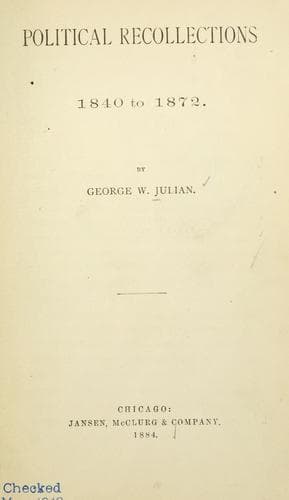
Political Recollections: 1840 to 1872Julian, George Washington
History
Political Recollections: 1840 to 1872
Julian, George Washington
Republican Party (U.S. : 1854- ) -- History; United States -- Politics and government
On the nineteenth of August Horace Greeley wrote his famous anti-
slavery letter to the President, entitled "The Prayer of Twenty
Millions." It was one of the most powerful appeals ever made in
behalf of justice and the rights of man. In his reply Mr. Lincoln
said: "If I could save the Union without freeing any slave, I
would do it; if I could save it by freeing all the slaves, I would
do it; and if I could save it by freeing some and leaving others
alone, I would do that." These words served as fresh fuel to the
fires of popular discontent, and they were responded to by Mr.
Greeley with admirable vigor and earnestness. The anti-slavery
critics of the President insisted that in thus dealing with slavery
as a matter of total indifference he likened himself to Douglas,
who had declared that he didn't care whether slavery was voted up
or voted down in the Territories. They argued that as slavery was
the cause of the war and the obstacle to peace, it was the duty of
the Government to lay hold of the conscience of the quarrel, and
strike at slavery as the grand rebel. Not to do so, they contended,
now that the opportunity was offered, was to make the contest a
mere struggle for power, and thus to degrade it to the level of
the wars of the Old World, which bring with them nothing for freedom
or the race. They insisted that the failure of the Government to
give freedom to our millions in bondage would be a crime only to
be measured by that of putting them in chains if they were free.
They reminded the President of his declaration that a house divided
against itself can not stand, and that the Republic can not
permanently exist half slave and half free; and they urged that
this baptism of fire and blood would be impious if the cause which
produced it should be spared to canker the heart of the nation
anew, and repeat its diabolical deeds. A Union with slavery spared
and reinstated would not be worth the cost of saving it. To argue
that we were fighting for a political abstraction called the Union,
and not for the destruction of slavery, was to affront common sense,
since nothing but slavery had brought the Union into peril, and
nothing could make sure the fruits of the war but the removal of
its cause. It was to delude ourselves with mere phrases, and
conduct the war on false pretenses. It was to rival the folly of
the rebels, who always asservated that they were not fighting for
slavery, but only for the right of local self government, when the
whole world knew the contrary. These ideas, variously presented
and illustrated, found manifold expression in innumerable Congressional
speeches and in the newspapers of the Northern States, and a month
later brought forth the President's proclamation of the twenty-
second of September, giving the insurgents notice that on the first
day of January following he would issue his proclamation of general
emancipation, if they did not in the meantime lay down their arms.
Public-domain text, read in full here on John Shaqi.
Reviews
Reviews
No reviews yet
Be the first to share your thoughts on this work.
Elsewhere in the archive
Join the Discussion
Join the discussion
Sign in to leave a comment or review.
Sign InorCreate an account