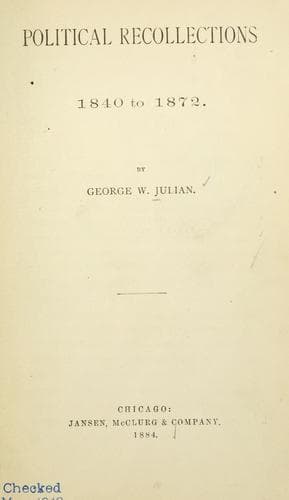
Political Recollections: 1840 to 1872Julian, George Washington
History
Political Recollections: 1840 to 1872
Julian, George Washington
Republican Party (U.S. : 1854- ) -- History; United States -- Politics and government
But to me the nomination of Andrew Johnson for Vice President was
a still greater disappointment. I knew he did not believe in the
principles embodied in the platform. I had become intimately
acquainted with him while we were fellow-members of the Committee
on the Conduct of the War, and he always scouted the idea that
slavery was the cause of our trouble, or that emancipation could
ever be tolerated without immediate colonization. In my early
acquaintance with him I had formed a different opinion; but he was,
at heart, as decided a hater of the negro and of everything savoring
of abolitionism, as the rebels from whom he had separated. His
nomination, however, like that of Mr. Lincoln, seemed to have been
preordained by the people, while the intelligent, sober men, in
Congress and out of Congress, who lamented the fact, were not
prepared to oppose the popular will. Mr. Lincoln's nomination was
nearly unanimous, only the State of Missouri opposing him; but of
the more earnest and through-going Republicans in both Houses of
Congress, probably not one in ten really favored it. It was not
only very distasteful to a large majority of Congress but to many
of the most prominent men of the party throughout the country.
During the month of June the feeling against Mr. Lincoln became
more and more bitter and intense, but its expression never found
its way to the people.
Notwithstanding the divisions which existed in the Republican ranks,
party discipline was vigorous and absolute. "Civil Service Reform"
was in the distant future, and the attempt to inaugurate it would
have been counted next to treasonable. Loyalty to Republicanism
was not only accepted as the best evidence of loyalty to the country,
but of fitness for civil position. After my nomination for re-
election this year, Mr. Holloway, who was still holding the position
of Commissioner of Patents, and one of the editors of a Republican
newspaper in my district, refused to recognize me as the party
candidate, and kept the name of my defeated competitor standing in
his paper. It threatened discord and mischief, and I went to the
President with these facts, and on the strength of them demanded
his removal from office. He replied, "If I remove Mr. Holloway I
shall have a quarrel with Senator Lane on my hands." I replied
that Senator Lane would certainly not quarrel with him for turning
a man out of office who was fighting the Republican party and the
friends of the Administration. "Your nomination," said he, "is as
binding on Republicans as mine, and you can rest assured that Mr.
Holloway shall support you, openly and unconditionally, or lose
his head." This was entirely satisfactory, but after waiting a
week or two for the announcement of my name I returned to Mr.
Lincoln with the information that Mr. Holloway was still keeping
up his fight, and that I had come to ask of him decisive measures.
I saw in an instant that the President now meant business. He
Public-domain text, read in full here on John Shaqi.
Reviews
Reviews
No reviews yet
Be the first to share your thoughts on this work.
Elsewhere in the archive
Join the Discussion
Join the discussion
Sign in to leave a comment or review.
Sign InorCreate an account