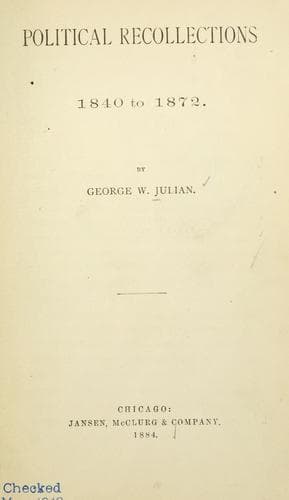
Political Recollections: 1840 to 1872Julian, George Washington
History
Political Recollections: 1840 to 1872
Julian, George Washington
Republican Party (U.S. : 1854- ) -- History; United States -- Politics and government
interested in seeing Drury's Landing, Dutch-Gap Canal, Malvern
Hill and other points of historic interest. Before reaching
Fortress Monroe the next day, Senators Wade and Chandler changed
their minds respecting our journey to Charleston, which was abandoned,
and after spending a few hours very pleasantly at that place and
Point Lookout, we reached Washington on the evening of the
fourteenth.
Soon after retiring I was roused from a deep sleep by loud raps at
my door. W. L. Woods, clerk of my committee, entered in the greatest
excitement, and told me that Lincoln had just been assassinated,
and Seward and son probably, and that rebel assassins were about
to take the town. Supposing all this to be true I grew suddenly
cold, heart-sick and almost helpless. It was a repetition of my
experience when the exaggerated stories about the Bull Run disaster
first reached me in the summer of 1861. I soon rallied, however,
and joined the throng on the street. The city was at once in a
tempest of excitement, consternation and rage. About seven and a
half o'clock in the morning the church bells tolled the President's
death. The weather was as gloomy as the mood of the people, while
all sorts of rumors filled the air as to the particulars of the
assassination and the fate of Booth. Johnson was inaugurated at
eleven o'clock on the morning of the 15th, and was at once surrounded
by radical and conservative politicians, who were alike anxious
about the situation. I spent most of the afternoon in a political
caucus, held for the purpose of considering the necessity of a new
Cabinet and a line of policy less conciliatory than that of Mr.
Lincoln; and while everybody was shocked at his murder, the feeling
was nearly universal that the accession of Johnson to the Presidency
would prove a god-send to the country. Aside from Mr. Lincoln's
known policy of tenderness to the Rebels, which now so jarred upon
the feelings of the hour, his well-known views on the subject of
reconstruction were as distasteful as possible to radical Republicans.
In his last public utterance, only three days before his death, he
had declared his adherence to the plan of reconstruction announced
by him in December, 1863, which in the following year so stirred
the ire of Wade and Winter Davis as an attempt of the Executive to
usurp the powers of Congress. According to this plan the work of
reconstruction in the rebel States was to be inaugurated and carried
on by those only who were qualified to vote under the Constitution
and laws of these States as they existed prior to the Rebellion.
Of course the negroes of the South could have no voice in framing
the institutions under which they were to live, and the question
of negro suffrage would thus have been settled by the President,
if he had lived and been able to maintain this policy, while no
doubt was felt that this calamity had now been averted and the way
opened for the radical policy which afterward involved the impeachment
Public-domain text, read in full here on John Shaqi.
Reviews
Reviews
No reviews yet
Be the first to share your thoughts on this work.
Elsewhere in the archive
Join the Discussion
Join the discussion
Sign in to leave a comment or review.
Sign InorCreate an account