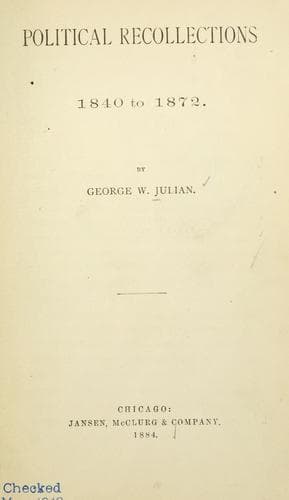
Political Recollections: 1840 to 1872Julian, George Washington
History
Political Recollections: 1840 to 1872
Julian, George Washington
Republican Party (U.S. : 1854- ) -- History; United States -- Politics and government
On the twenty-first of April I joined a large crowd of Indianans
in one of the calls on the President referred to at the close of
the last chapter. Gov. Morton headed the movement, which I now
found had a decidedly political significance. He read a lengthy
and labored address on "The Whole Duty of Man" respecting the
question of Reconstruction. He told the President that a State
could "neither secede nor by any possible means be taken out of
the Union"; and he supported and illustrated this proposition by
some very remarkable statements. He elaborated the proposition
that the loyal people of a State have the right to govern it; but
he did not explain what would become of the State if the people
were all disloyal, or the loyal so few as to be utterly helpless.
The lawful governments of the South were overthrown by treason;
and the Governor declared there was "no power in the Federal
Government to punish the people of a State collectively, by reducing
it to a territorial condition, since the crime of treason is
individual, and can only be treated individually." According to
this doctrine a rebellious State become independent. If the people
could rightfully be overpowered by the national authority, that
very fact would at once re-clothe them in all their rights, just
as if they had never rebelled. In framing their new governments
Congress would have no right to prescribe any conditions, or to
govern them in any way pending the work of State reconstruction,
since this would be to recognize the States as Territories, and
violate the principle of State rights. The Governor's theory of
reconstruction, in fact, made our war for the Union flagrantly
unconstitutional. The crime of treason being "individual," and
only to "be treated individually," we had no right to hold prisoners
of war, seize property, and capture and confiscate vessels, without
a regular indictment and trial; and this being so, every Rebel in
arms was in the full legal possession of his political rights, and
no power could prevent him from exercising them except through
judicial conviction of treason in the district in which the overt
act was committed. Singularly enough, he seemed entirely unaware
of the well-settled principle which made our war for the Union a
territorial conflict, like that of a war with Mexico or England;
that the Rebels, while still liable to be hung or otherwise dealt
with for treason, had taken upon themselves the further character
of public enemies; and that being now conquered they were conquered
enemies, having simply the rights of a conquered people. The
Governor further informed the President that if the revolted
districts should be dealt with as mere Territories, or conquered
provinces, the nation would be obliged to pay the debts contracted
by them prior to the war. These remarkable utterances, which he
repudiated in less than a year afterward, were emphatically endorsed
by the President, who entered upon the same theme at a dismal
Public-domain text, read in full here on John Shaqi.
Reviews
Reviews
No reviews yet
Be the first to share your thoughts on this work.
Elsewhere in the archive
Join the Discussion
Join the discussion
Sign in to leave a comment or review.
Sign InorCreate an account