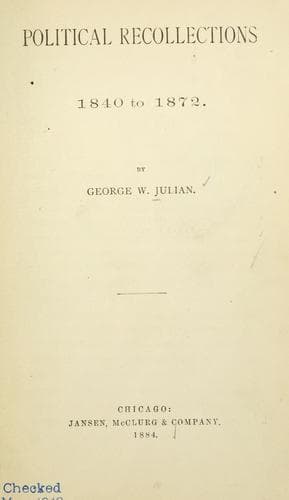
Political Recollections: 1840 to 1872Julian, George Washington
History
Political Recollections: 1840 to 1872
Julian, George Washington
Republican Party (U.S. : 1854- ) -- History; United States -- Politics and government
The tide was at length so evidently turning in my favor
that on the 28th of September Governor Morton was induced to make
his elaborate speech at Richmond, denouncing the whole theory of
Republican reconstruction as subsequently carried out, and opposing
the policy of negro suffrage by arguments which he seemed to regard
as overwhelming. He made a dismal picture of the ignorance and
degradation of the plantation negroes of the South, and scouted
the policy of arming them with political power. But their fitness
for the ballot was a subordinate question. A great national
emergency pleaded for their right to it on other and far more
imperative grounds. The question involved the welfare of both
races, and the issues of the war. It involved not merely the fate
of the negro, but the safety of society. It was, moreover, a
question of national honor and gratitude, from which no escape was
morally possible. To leave the ballot in the hands of the ex-
rebels, and withhold it from these helpless millions, would be to
turn them over to the unhindered tyranny and misrule of their
enemies, who were then smarting under the humiliation of their
failure, and making the condition of the freedmen more intolerable
than slavery itself, through local laws and police regulations.
The Governor referred to the Constitution and laws of Indiana,
denying the ballot to her intelligent negroes, and subjecting
colored men to prosecution and fine for coming into the State; and
asked with what face her people could insist upon conferring the
suffrage upon the negroes of the Southern States? But this was an
evasion of the question. The people of Indiana had no right to
take advantage of their own wrong, or to sacrifice the welfare of
four million blacks on the altar of Northern consistency. He should
have preached the duty of practical repentance in Indiana, instead
of making the sins of her people an excuse for a far greater
inhumanity to the negroes of the South.
He urged that the policy of negro suffrage would give the lie to
all the arguments that had ever been employed against slavery as
degrading and brutalizing to its victims. He said it was "to pay
the highest compliment to the institution of slavery," and "stultify
ourselves." But this was belittling a great national question, by
the side of which all considerations of party consistency were
utterly trivial and contemptible. The ballot for the negro was a
logical necessity, and it was a matter of the least possible
consequence whether the granting of it would "stultify ourselves"
or not.
Public-domain text, read in full here on John Shaqi.
Reviews
Reviews
No reviews yet
Be the first to share your thoughts on this work.
Elsewhere in the archive
Join the Discussion
Join the discussion
Sign in to leave a comment or review.
Sign InorCreate an account