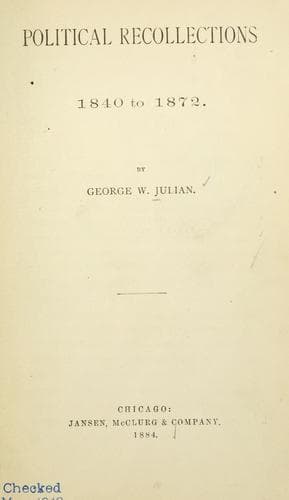
Political Recollections: 1840 to 1872Julian, George Washington
History
Political Recollections: 1840 to 1872
Julian, George Washington
Republican Party (U.S. : 1854- ) -- History; United States -- Politics and government
This uncomely sparring match seemed to have no significance at the
time beyond the amusement it afforded and the personal discredit
it attached to the combatants; but in its later consequences it
has not only seriously involved the political fortunes of both
these ambitious men, but rent the Republican party itself into
warring factions. Still more, it has connected itself in the same
way, and not very remotely, with the nomination of General Garfield
in 1880, and his subsequent assassination. Such are the strange
political revenges of a personal quarrel.
During this session of Congress the policy of Military Land Bounties
was very earnestly agitated, and threatened the most alarming
consequences. Probably no great question has been so imperfectly
understood by our public men as the land question, and the truth
of this is attested by the multiplied schemes of pillage and plunder
to which the public domain has been exposed within the past thirty
or forty years. Among these the project of Land Bounties to soldiers
has been conspicuous. Of the millions of acres disposed of by the
Government through assignable land-warrants in the pretended interest
of the soldiers of the Mexican War a very small fraction was
appropriated to their use. The great body of the land fell into
the hands of monopolists, who thus hindered the settlement and
productive wealth of the country, while the sum received by the
soldier for his warrant was in very many cases a mere mockery of
his just claims, and in no instance an adequate bounty. The policy,
however, had become traditional, and now, at the close of the
grandest of all our wars, it was quite natural for the country's
defenders to claim its supposed benefits. Congress was flooded
with their petitions, and it required uncommon political courage
to oppose their wishes. It was very plausibly urged that the
Nation, with its heavy load of debt, could not pay a bounty in
money, and that it should be done by drawing liberally upon the
thousand million acres of the public domain. Some of the advocates
of this policy openly favored the repeal of the Homestead law for
this purpose, just as Thurlow Weed, earlier in the war, had demanded
its repeal so that our public lands could be mortgaged to European
capitalists in security for the money we needed to carry on the
struggle. The situation became critical. Everybody was eager to
reward the soldier, and especially the politicians; and there seemed
to be no other way to do it than by bounties in land, for which
all our previous wars furnished precedents. The House Committee
on Public Lands considered the question with great care and anxiety,
and in the hope of check-mating that project made a report in
response to one of the many petitions for land bounty which had
been referred to it, embodying some very significant facts. It
showed that more than two millions and a quarter of soldiers would
be entitled to a bounty in land, and that it would require more
Public-domain text, read in full here on John Shaqi.
Reviews
Reviews
No reviews yet
Be the first to share your thoughts on this work.
Elsewhere in the archive
Join the Discussion
Join the discussion
Sign in to leave a comment or review.
Sign InorCreate an account