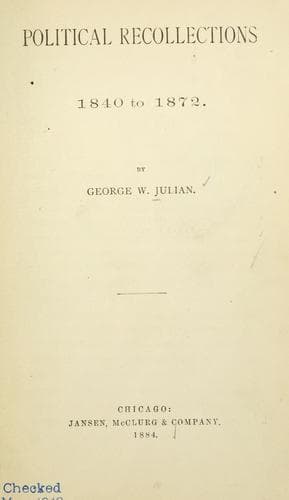
Political Recollections: 1840 to 1872Julian, George Washington
History
Political Recollections: 1840 to 1872
Julian, George Washington
Republican Party (U.S. : 1854- ) -- History; United States -- Politics and government
The action of the Government in dealing with the mineral lands of
the United States forms one of the most curious chapters in the
history of legislation. It had its beginning in the famous
Congressional Ordinance of May 20, 1785, which reserved one third
part of all gold, silver, lead and copper mines to be sold or
otherwise disposed of as Congress might direct. From this time
till the discovery of gold in California in 1848, the legislation
of Congress respecting mineral lands related exclusively to those
containing the base or merely useful metals, and applied only to
the regions now embraced by the States of Michigan, Wisconsin,
Iowa, Illinois and Missouri. The policy of reserving mineral lands
from sale was obviously of feudal origin, and naturally led to the
leasing of such lands by the Government, which was inaugurated by
the Act of Congress of March 3, 1807. The Act of Congress of March
3, 1829, provided for the sale of the reserved lead mines and
contiguous lands in Missouri, on six months' notice, but mineral
lands elsewhere remained reserved, and continued to be leased by
the Government. This policy was thoroughly and perseveringly tried,
and proved utterly unprofitable and ruinous. President Polk, in
his message of December 2, 1845, declared that the income derived
from the leasing system for the years 1841, 1842, 1843 and 1844
was less than one fourth of its expense, and he recommended its
abolition, and that these lands be brought into market. The leasing
policy drew into the mining regions a population of vagrants, idlers
and gamblers, who resisted the payment of tax on the product of
the mines, and defied the agents of the Government. It excluded
sober and intelligent citizens, and hindered the establishment of
organized communities and the development of the mines. The miners
were violently opposed to the policy of sale, but the evils incident
to the leasing policy became so intolerable that the Government
was at length obliged to provide for the sale of the lands in fee,
which it did by Acts of Congress of July 11, 1846, and March 1 and
3, 1847. The tracts occupied and worked by the miners under their
leases possessed every variety of shape and boundary, but there
were no difficulties which were not readily adjusted under the
rectangular system of surveys and the regulations of the Land
Department. A new class of men at once took possession of these
regions as owners of the soil, brought their families with them,
laid the foundations of social order, expelled the semi-barbarians
who had secured a temporary occupancy, and thus, at once promoted
their own welfare, the prosperity of the country, and the financial
interests of the Government. Under this reformed policy the lead
and copper lands of the regions named were disposed of in fee.
Public-domain text, read in full here on John Shaqi.
Reviews
Reviews
No reviews yet
Be the first to share your thoughts on this work.
Elsewhere in the archive
Join the Discussion
Join the discussion
Sign in to leave a comment or review.
Sign InorCreate an account