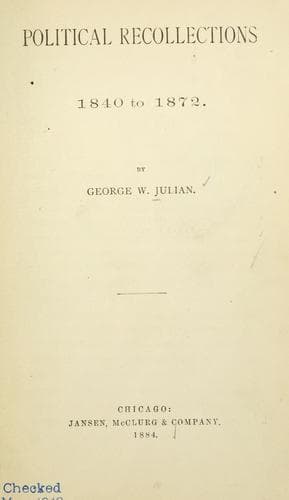
Political Recollections: 1840 to 1872Julian, George Washington
History
Political Recollections: 1840 to 1872
Julian, George Washington
Republican Party (U.S. : 1854- ) -- History; United States -- Politics and government
But although this measure fully protected all miners in the right
of exploration and discovery, and carefully guarded against any
interference with vested rights, the idea was in some way rapidly
and extensively propagated that it contemplated a sweeping confiscation
of all their claims, and the less informed among them became wild
with excitement. The politicians of California and Nevada, instead
of endeavoring to enlighten them and quiet this excitement, yielded
to it absolutely. They became as completely its instruments as
they have since been of the Anti-Mongolian feeling. They argued,
at first, that no Congressional legislation was necessary, and that
while the Government should retain the fee of these lands, the
miners should have the entire control of them under regulations
prescribed by themselves. This, it was believed, would placate
the miners and settle the question; but the introduction of the
measure referred to, and the agitation of the question, had made
some form of legislation inevitable, and the question now was to
determine what that legislation should be. Senators Conness of
California, and Stewart of Nevada, who were exceedingly hostile to
the bill I had introduced, and feared its passage, sought to avert
it by carrying through the Senate "a bill to regulate the occupation
of mineral lands and to extend the right of pre-emption thereto,"
which they hoped would satisfy their constituents and prevent
further legislation. They supported it as the next best thing to
total non-action by Congress. It provided for giving title to the
miners, but it did this by practically abdicating the jurisdiction
of the National Government over these lands, with its recognized
and well-settled machinery for determining all questions of title
and boundary, and handing them over to "the local custom or rules
of the miners." These "local rules" were to govern the miner in
the location, extension and boundary of his claim, the manner of
developing it, and the survey also, which was not to be executed
with any reference to base lines as in the case of other public
lands, but in utter disregard of the same. The Surveyor General
was to make a plat or diagram of the claim, and transmit it to the
Commissioner of the General Land Office, who, as the mere agent
and clerk of the miner, with no judicial authority whatever, was
required to issue the patent. In case of any conflict between
claimants it was to be determined by the "local courts," without
any right of appeal to the local land offices, the General Land
Office, or to the Federal courts. The Government was thus required
to part with its lands by proceedings executed by officials wholly
outside of its jurisdiction, and irresponsible to its authority.
The act not only abolished our rectangular system of surveys, but
still further insulted the principles of mathematics and the dictates
of common sense by providing that the claimant should have the
Public-domain text, read in full here on John Shaqi.
Reviews
Reviews
No reviews yet
Be the first to share your thoughts on this work.
Elsewhere in the archive
Join the Discussion
Join the discussion
Sign in to leave a comment or review.
Sign InorCreate an account