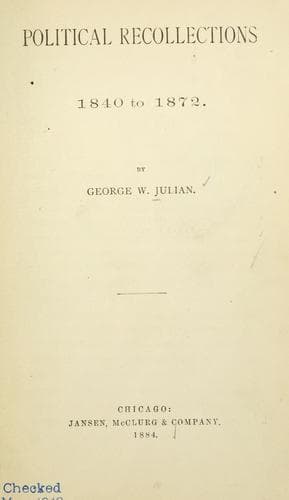
Political Recollections: 1840 to 1872Julian, George Washington
History
Political Recollections: 1840 to 1872
Julian, George Washington
Republican Party (U.S. : 1854- ) -- History; United States -- Politics and government
On the meeting of Congress in December the signs of political
progress since the adjournment were quite noticeable. The subject
of impeachment began to be talked about, and both houses seemed
ready for all necessary measures. Since mingling freely with their
constituents, very few Republican members insisted that the XIV
Constitutional Amendment should be accepted as a finality, or as
an adequate solution of the problem of reconstruction. The second
section of that amendment, proposing to abandon the colored race
in the South on condition that they should not be counted in the
basis of representation, was now generally condemned, and if the
question had been a new one it could not have been adopted. This
enlightenment of Northern representatives was largely due to the
prompt and contemptuous rejection by the rebellious States of the
XIV Amendment as a scheme of reconstruction, and their enactment
of black codes which made the condition of the freedmen more
deplorable than slavery itself. In this instance, as in that of
Mr. Lincoln's Proclamation of Emancipation, it was rebel desperation
which saved the negro; for if the XIV Amendment had been at first
accepted, the work of reconstruction would have ended without
conferring upon him the ballot. This will scarcely be denied by
any one, and has been frankly admitted by some of the most
distinguished leaders of the party.
The policy of treating these States as Territories seemed now to
be rapidly gaining ground, and commended itself as the only logical
way out of the political dilemma in which the Government was placed.
But here again the old strife between radicalism and conservatism
cropped out. The former opposed all haste in the work of
reconstruction. It insisted that what the rebellious districts
needed was not an easy and speedy return to the places they had
lost by their treasonable conspiracy, but a probationary training,
looking to their restoration when they should prove their fitness
for civil government as independent States. It was insisted that
they were not prepared for this, and that with their large population
of ignorant negroes and equally ignorant whites, dominated by a
formidable oligarchy of educated land-owners who despised the power
that had conquered them, while they still had the sympathy of their
old allies in the North, the withdrawal of Federal intervention
and the unhindered operation of local supremacy would as fatally
hedge up the way of justice and equality as the rebel despotisms
then existing. The political and social forces of Southern society,
if unchecked from without, were sure to assert themselves, and the
more decided anti-slavery men in both houses of Congress so warned
the country, and foretold that no theories of Democracy could avail
unless adequately supported by a healthy and intelligent public
opinion. They saw that States must grow, and could not be suddenly
constructed where the materials were wanting, and that forms are
Public-domain text, read in full here on John Shaqi.
Reviews
Reviews
No reviews yet
Be the first to share your thoughts on this work.
Elsewhere in the archive
Join the Discussion
Join the discussion
Sign in to leave a comment or review.
Sign InorCreate an account