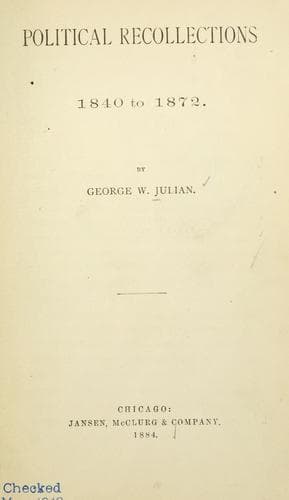
Political Recollections: 1840 to 1872Julian, George Washington
History
Political Recollections: 1840 to 1872
Julian, George Washington
Republican Party (U.S. : 1854- ) -- History; United States -- Politics and government
The freedmen were completely in the power of their
old masters, so long as the latter might refuse the terms of
reconstruction that were offered; and they had the option to refuse
them entirely, if they saw fit to prefer their own mad ascendancy
and its train of disorders to compulsory restoration. This perfectly
inexcusable abandonment of negro suffrage was zealously defended
by a small body of conservative Republicans who were still lingering
in the sunshine of executive favor, and of whom Mr. Blaine was the
chief; and it was through the timely action of Mr. Shellabarger,
of Ohio, which these conservatives opposed, that the scheme of
reconstruction was finally so amended as to make the Rebel State
governments provisional only, and secure the ballot to the negro
during the period, whether long or short, which might intervene
prior to the work of re-admission. This provision was absolutely
vital, because it took from the people of the insurrectionary
districts every motive for refusing the acceptance of the terms
proposed, and settled the work of reconstruction by this exercise
of absolute power by their conquerors. It was this provision which
secured the support of the Radical Republicans in Congress; but it
did not meet their objections to this scheme of hasty military
reconstruction, while these objections have been amply justified
by time.
Thaddeus Stevens never appeared to such splendid advantage as a
parliamentary leader as in this protracted debate on reconstruction.
He was then nearly seventy-six, and was physically so feeble that
he could scarcely stand; but his intellectual resources seemed to
be perfectly unimpaired. Eloquence, irony, wit, and invective,
wre charmingly blended in the defense of his positions and his
attacks upon his opponents. In dealing with the views of Bingham,
Blaine, and Banks, he was by no means complimentary. He referred
to them in his closing speech on the bill, on the thirteenth of
February, when he said, in response to an interruption by Mr.
Blaine, "What I am speaking of is this proposed step toward universal
amnesty and universal Andy-Johnsonism. If this Congress so decides,
it will give me great pleasure to join in the _io triumphe_ of the
gentleman from Ohio in leading this House, possibly by forbidden
paths, into the sheep-fold or the goat-fold of the President." In
speaking of the amendment to the bill offered by General Banks, he
said, "It proposes to set up a contrivance at the mouth of the
Mississippi, and by hydraulic action to control all the States that
are washed by the waters of that great stream." He declared that,
"The amendment of the gentleman from Maine lets in a vast number
of Rebels, and shuts out nobody. All I ask is that when the House
comes to vote upon that amendment, it shall understand that the
adoption of it would be an entire surrender of those States into
the hands of the Rebels. * * * If, sir, I might presume upon my
Public-domain text, read in full here on John Shaqi.
Reviews
Reviews
No reviews yet
Be the first to share your thoughts on this work.
Elsewhere in the archive
Join the Discussion
Join the discussion
Sign in to leave a comment or review.
Sign InorCreate an account