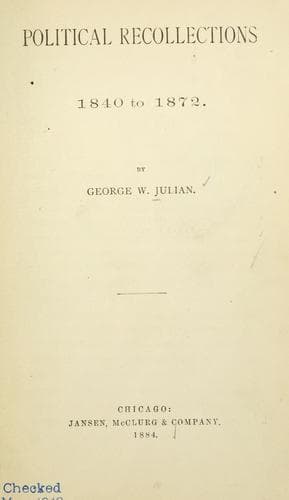
Political Recollections: 1840 to 1872Julian, George Washington
History
Political Recollections: 1840 to 1872
Julian, George Washington
Republican Party (U.S. : 1854- ) -- History; United States -- Politics and government
The resolution was adopted by yeas one hundred, nays eighteen, and
the announcement of the vote provoked the laughter of both sides
of the House. It gratified the Republicans, because it was a thrust
at Andrew Johnson, and perfectly accorded with their prevailing
political mood, which was constantly becoming more embittered toward
him. It equally gratified the Democrats, because they at once
accepted it as a telling shot at Gov. Morton, who had fathered the
condemned heresy nearly two years before in his famous Richmond
speech, which he and his friends had been doing their best to
forget. Party feeling had never before been more intense; but this
resolution performed its mediatorial office with such magical effect
in playing with two utterly diverse party animosities, that
Republicans and Democrats were alike surprised to find themselves
suddenly standing on common ground, and joyfully shaking hands in
token of this remarkable display of their good fellowship.
Congress assembled again on the twenty-first of November, in
consequence of the extraordinary conduct of the President. The
popular feeling in favor of impeachment had now become formidable,
and on the twenty-fifth the Judiciary Committee of the House finally
reported in favor of the measure. The galleries were packed, and
the scene was one of great interest, while all the indications
seemed to point to success; but on the seventh of December, the
proposition was voted down by yeas fifty-seven, nays one hundred
and eight. The vote was a great surprise and disappointment to
the friends of impeachment, and was construed by them as a wanton
surrender by Congress, and the prelude to new acts of executive
lawlessness. These acts continued to be multiplied, and the removal
of Secretary Stanton finally so prepared the way that on the twenty-
fourth of February, 1868, the House, by a vote of one hundred and
twenty-six to forty-seven, declared in favor of impeachment. The
crowds in the galleries, in the lobbies, and on the floor were
unprecedented, and the excitement at high tide. The fifty-seven
who had voted for impeachment in December, were now happy. They
felt, at last, that the country was safe. The whole land seemed
to be electrified, as they believed it would have been at any
previous time if the House had had the nerve to go forward; and
they rejoiced that the madness of Johnson had at last compelled
Congress to face the great duty. A committee of seven was appointed
by the Speaker to prepare articles of impeachment, of whom Thaddeus
Stevens was chairman. He was now rapidly failling in strength, and
every morning had to be carried up stairs to his seat in the House;
but his humor never failed him, and on one of these occasions he
said to the young men who had him in charge, "I wonder, boys, who
will carry me when you are dead and gone." He was very thin, pale
and haggard. His eye was bright, but his face was "scarred by the
Public-domain text, read in full here on John Shaqi.
Reviews
Reviews
No reviews yet
Be the first to share your thoughts on this work.
Elsewhere in the archive
Join the Discussion
Join the discussion
Sign in to leave a comment or review.
Sign InorCreate an account