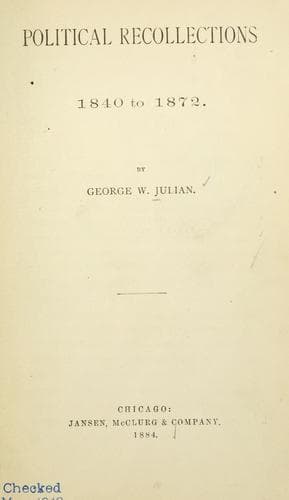
Political Recollections: 1840 to 1872Julian, George Washington
History
Political Recollections: 1840 to 1872
Julian, George Washington
Republican Party (U.S. : 1854- ) -- History; United States -- Politics and government
After the presidential election I went to Washington, where I met
Chief Justice Chase in the Supreme Court and accepted an invitation
to dine with him. He looked so wasted and prematurely old that I
scarcely knew him. He was very genial, however, and our long
political talk was exceedingly enjoyable. It seemed to afford him
much satisfaction to show me a recently reported dissenting opinion
of his in which he re-asserted his favorite principle of State
rights. I only met him once afterward, and this was at the
inauguration of General Grant. I called on Mr. Sumner the same
evening, and found him in a wretched state of health, which was
aggravated by the free use of poisonous drugs. He seemed very much
depressed, politically. He had lost caste with the great party
that had so long idolized him, and which he had done so much to
create and inspire. He had been deserted by the colored race, to
whose service he had unselfishly dedicated his life. He had been
degraded from his honored place at the head of the Senate Committee
on Foreign Relations, and for no other reason than the faithful
and conscientious performance of his public duty. He had been
rebuked by the Legislature of his own State. His case strikingly
suggested that of John Quincy Adams in 1807, when the anathemas of
Massachusetts were showered upon him for leaving the Federalist
party when it had accomplished its mission and survived its character,
and joining the supporters of Jefferson. I sympathized with him
profoundly; but his case was not so infinitely sad as that of poor
Greeley, over whose death, however, the whole Nation seemed to be
in mourning. He had greatly overtaxed himself in his masterly and
brilliant campaign on the stump, in which he displayed unrivaled
intellectual resources and versatility. He had exhausted himself
in watching by the bedside of his dying wife. He had been assailed
as the enemy of his country by the party which he had done more
than any man in the Nation to organize. He had been hunted to his
grave by political assassins whose calumnies broke his heart. He
was scarcely less a martyr than Lincoln, or less honored after his
death, and his graceless defamers now seemed to think they could
atone for their crime by singing his praises. It is easy to speak
well of the dead. It is very easy, even for base and recreant
characters, to laud a man's virtues after he has gone to his grave
and can no longer stand in their path. It is far easier to praise
the dead than do justice to the living; and it was not strange,
therefore, that eminent clergymen and doctors of divinity who had
silently witnessed the peltings of Mr. Greeley by demagogues and
mercenaries during the canvass now poured out their eloquence at
his grave. What he had sorely needed and was religiously entitled
to was the sympathy and succor of good men while he lived, and
especially in his heroic struggle for political reconciliation and
reform.
Public-domain text, read in full here on John Shaqi.
Reviews
Reviews
No reviews yet
Be the first to share your thoughts on this work.
Elsewhere in the archive
Join the Discussion
Join the discussion
Sign in to leave a comment or review.
Sign InorCreate an account