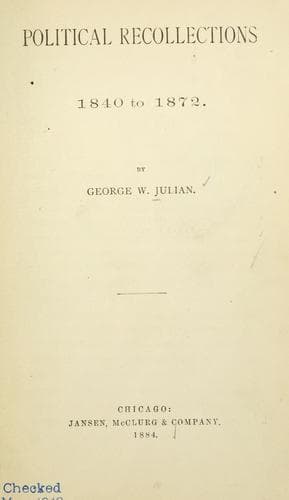
Political Recollections: 1840 to 1872Julian, George Washington
History
Political Recollections: 1840 to 1872
Julian, George Washington
Republican Party (U.S. : 1854- ) -- History; United States -- Politics and government
I have already referred to several of the conspicuous characters
whose names I have grouped. Such men as Collamer, Fessenden,
Browning and Trumbull, were among the famous lawyers and conservatives
on the Republican side of the Senate. They were conscientious and
unflinching partisans, but were studiously anxious to save the
Union according to the Constitution, and deprecated all extreme
and doubtful measures. Opposed to them stood Sumner, Wade, Chandler,
and their radical associates, who believed in saving the Union at
all hazards, and that not even the Constitution should be allowed
to stay the arm of the Government in blasting the power of the
Rebels. It was perhaps fortunate for the country that these
divisions existed, and held each other in check. Mr. Collamer was
the impersonation of logical force and the beau ideal of a lawyer
and judge. There was a sort of majesty in the figure and brow of
Fessenden when addressing the Senate, and his sarcasm was as keen
as it was inimitable; but his nature was kindly, and his integrity
perfect. Trumbull was a less commanding figure, but he greatly
honored his position as chairman of the Judiciary Committee of the
Senate, and his memory will be held in perpetual remembrance as
the author of the Civil Rights Bill and of the XIII Amendment to
the Constitution. Sumner, I think, was the purest man in the
Senate, if not the ablest. He was pre-eminently the hero of duty,
and the servant of what he believed to be the truth. No man could
have made a more absolute surrender of himself to his country in
the great conflict which threatened its life. His weary and jaded
look always excited my sympathy, for he seemed to be sacrificing
all the joys of life, and life itself, in his zeal for the public
service. I knew Wade more intimately than any man in the Senate,
through my association with him as a member of the same Committee
for successive years, and was always interested in his personal
traits and peculiarities. He was "a man of uncommon downrightness."
There was even a sort of fascination about his profanity. It had
in it a spontaniety and heartiness which made it almost seem the
echo of a virtue. It was unlike the profane words of Thaddeus
Stevens, which were frequently carried on the shafts of his wit
and lost in the laughter it provoked. Edmunds, now so famous as
a lawyer, and leader in the Senate, and so well known by his reputed
resemblance to St. Jerome, was simply respectable on his first
appearance; but his ability, industry, and constant devotion to
his duties soon gave him rank among the prominent men in that body.
Grimes of Iowa was one of the really strong men of this period,
while Harlan, his colleague, possessed a vigor and grasp of mind
which I think the public never fully accorded him. Lane of Indiana
was full of patriotic ardor, and like Baker of Oregon, had the rare
gift of eloquent impromptu speech. Henry Wilson earned the gratitude
Public-domain text, read in full here on John Shaqi.
Reviews
Reviews
No reviews yet
Be the first to share your thoughts on this work.
Elsewhere in the archive
Join the Discussion
Join the discussion
Sign in to leave a comment or review.
Sign InorCreate an account