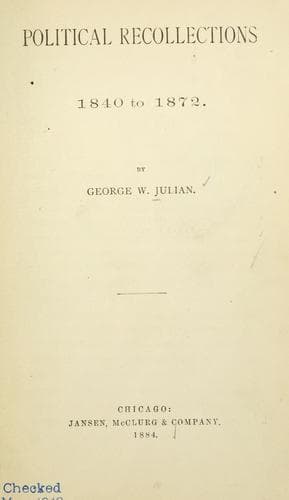
Political Recollections: 1840 to 1872Julian, George Washington
History
Political Recollections: 1840 to 1872
Julian, George Washington
Republican Party (U.S. : 1854- ) -- History; United States -- Politics and government
James Brooks was always a conspicuous figure on the Democratic side
of the House. I first knew him in the log cabin days of 1840, and
afterward served with him in the Congress of 1849. He was a man
of ability, a genuine hater of the negro, and a bitter partisan;
but I never saw any reason to doubt his personal integrity, and I
think the affair which threw so dark a cloud over his reputation
in later years was a surprise to all who knew him. Michael C. Kerr
was one of the very first men in the House, and a man of rare purity
and worth. Randall, like Garfield, was a growing man during the
war, and through his ambition, natural abilities, and Congressional
training, he became one of the chief magnates of his party.
Pendleton was counted an able man, and made his mark as a Bourbon
Democrat and the champion of hard money; but he subsequently spoiled
his financial record by his scheme for flooding the country with
greenbacks. Vallandigham was conspicuous for his intellectual
vigor, passionate earnestness, and hatred of Abolitionism. He had
the courage of his opinions. The Republicans hated him consumedly.
He was a member of the House Committee on Public Lands, which
reported the Homestead Bill, and I remember that no Republican
member, except the chairman, showed the slightest disposition to
recognize him. After the war was ended, however, and the work of
reconstruction was accomplished, his temper and qualities seemed
to have spent much of their force. He was among the very first to
plead for acquiescence and the policy of reconciliation; and if
his life had been spared I believe his catholic spirit and active
leadership in the "New Departure" would have re-instated him in
the sincere regard of men of all parties. Lovejoy was the most
impassioned orator in the House. His speeches were remarkable for
their pungency and wit, and when the question of slavery was under
discussion his soul took fire. He hated slavery with the animosity
of a regular Puritan, and when he talked about it everybody listened.
Wickliffe of Kentucky was one of the most offensive representatives
of the Border State policy, and whenever he spoke Lovejoy was sure
to follow. As often as Wickliffe got the floor it was noticed that
Lovejoy's brow was immediately darkened in token of the impending
strife, while his friends and enemies prepared themselves for the
scene. Wickliffe was a large, fierce-looking man, with a shrill
voice, and quite as belligerent as Lovejoy; and their contests were
frequent, and always enjoyed by the House, and for some time became
a regular feature of its business.
Public-domain text, read in full here on John Shaqi.
Reviews
Reviews
No reviews yet
Be the first to share your thoughts on this work.
Elsewhere in the archive
Join the Discussion
Join the discussion
Sign in to leave a comment or review.
Sign InorCreate an account