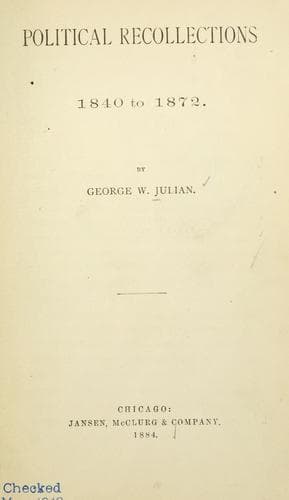
Political Recollections: 1840 to 1872Julian, George Washington
History
Political Recollections: 1840 to 1872
Julian, George Washington
Republican Party (U.S. : 1854- ) -- History; United States -- Politics and government
Oakes Ames was one of the members of the House with whom I was best
acquainted. I thought I knew him well, and I never had the slightest
reason to suspect his public or private integrity. Personally and
socially he was one of the kindliest men I ever knew, and I was
greatly surprised when I learned of his connection with the Credit
Mobilier project. It first found its way into politics through a
speech of Horace Greeley near the close of the canvass of 1872,
but it had been fully exposed by Washburn of Wisconsin in a speech
in Congress in the year 1868. The history of its connection with
American politics and politicians forms an exceedingly interesting
and curious chapter. The fate of the men involved in it seems like
a perfect travesty of justice and fair play. Some of them have
gone down under the waves of popular condemnation. Others, occupying
substantially the same position, according to the evidence, have
made their escape and even been honored and trusted by the public,
while still others are quietly whiling away their lives under the
shadow of suspicion. The case affords a strange commentary upon
the principle of historic justice.
One of the most remarkable facts connected with the first years of
the war was the descent of the Abolitionists upon Washington. They
secured the hall of the Smithsonian Institute for their meetings,
which they held weekly, and at which the Rev. John Pierpont presided.
It was with much difficulty that the hall was procured, and one of
the conditions of granting it was that it should be distinctly
understood and announced that the Smithsonian Institute was to be
in no way responsible for anything that might be said by the
speakers. This was very emphatically insisted on by Professor
Henry, and was duly announced at the first meeting. At the following,
and each succeeding lecture, Mr. Pierpont regularly made the same
announcement. These gatherings were largely attended and very
enthusiastic; and as the anti-slavery tide constantly grew stronger,
the weekly announcement that "the Smithsonian Institute desires it
to be distinctly understood that it is not to be held responsible
for the utterances of the speakers," awakened the sense of the
ludicrous, and called forth rounds of applause and explosions of
laughter by the audience, in front of which Professor Henry was
seated. Each meeting thus began with a frolic of good humor, which
Mr. Pierpont evidently enjoyed, for he made his announcement with
a gravity which naturally provoked the mirth which followed. These
meetings were addressed by Wendell Phillips, Gerrit Smith, Ralph
Waldo Emerson, Dr. Brownson, and other notable men, and were enjoyed
as a sort of jubilee by the men and women who attended them.
Public-domain text, read in full here on John Shaqi.
Reviews
Reviews
No reviews yet
Be the first to share your thoughts on this work.
Elsewhere in the archive
Join the Discussion
Join the discussion
Sign in to leave a comment or review.
Sign InorCreate an account