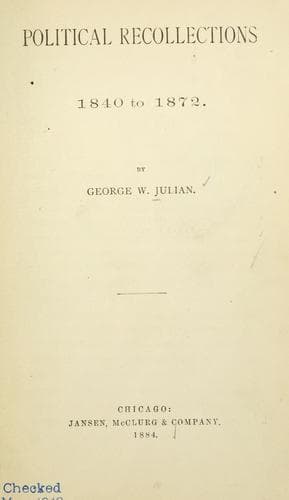
Political Recollections: 1840 to 1872Julian, George Washington
History
Political Recollections: 1840 to 1872
Julian, George Washington
Republican Party (U.S. : 1854- ) -- History; United States -- Politics and government
frequently applauded. Mr. Clay spoke at night to a still larger
audience, while perfect order prevailed. So far our success seemed
gratifying, and Mr. Fee was delighted; and we proceeded the following
morning to our next appointment at Brooksville, in Bracken county.
Here we found assembled a large crowd of that brutalized rabble
element which formed the background of slavery everywhere. The
aboriginal creatures gazed at us like so many wild animals, but
showed not the slightest disposition to enter the house in which
we were to speak. Mr. Clay remarked that they must be Whigs, since
they did not seemed inclined to "resist," but only to "discountenance"
our agitation; but we had come to speak, and with Mr. Fee's family
and a few friends who had come with us for an audience, we spoke
about an hour and a half each, just as if the house had been filled.
A few straggled in during the speaking, and several hung about the
windows and listened, though they tried to seem not to do so; but
the most remarkable and praiseworthy thing about this congregation
of Yahoos was that they did not mob us. It must have seemed to
them a strange waste of power to spare such notorious disturbers
of the peace, and return to their homes without any laurels. This
ended our work in Kentucky, where we could boast that the "finality"
platform had been openly set at defiance, and I returned to my work
on the other side of the Ohio.
Later in the canvass, on my return from Wisconsin and Illinois, I
learned that Andrew L. Robinson, the Free Soil candidate for Governor
of Indiana, had been mobbed in the city of Terre Haute, and prevented
from making an anti-slavery speech. This was not surprising, as
this section of the State was largely settled by people from
Maryland, Virginia, and Kentucky, who were as intolerant of
abolitionism as those of Bracken county already described. I
immediately sent a telegram making an appointment to speak in that
city, and on the day appointed reported for duty. I found my
friends uneasy and apprehensive. They evidently regretted my
coming, and some of them advised me quietly to return home. The
town was full of rumors that I was not to be allowed to speak, and
was to be "wabashed," as the rowdies phrased it. But I had no
thought of returning without being heard; and accordingly, at the
appointed hour, I repaired to the court house, where I found a
small crowd assembled, with restless countenances, and a gang of
ruffians outside, armed with stones and brickbats. The audience
gradually increased, and as I began to speak I noticed that the
roughs themselves began to listen, which they continued to do during
the hour and a half I devoted to the most unmistakable utterances
on the slavery question. The ringleader of the mob, for some
reason, failed to give the signal of attack, and free speech was
vindicated. Timid men grew brave, and boasted of the love of order
that had prompted the people of the town to stand by my rights;
Public-domain text, read in full here on John Shaqi.
Reviews
Reviews
No reviews yet
Be the first to share your thoughts on this work.
Elsewhere in the archive
Join the Discussion
Join the discussion
Sign in to leave a comment or review.
Sign InorCreate an account