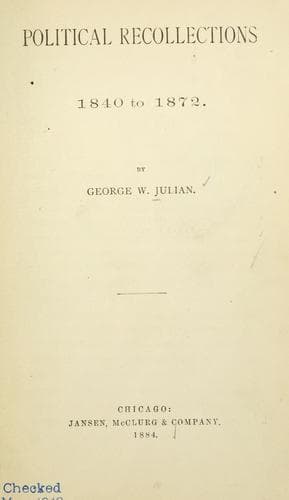
Political Recollections: 1840 to 1872Julian, George Washington
History
Political Recollections: 1840 to 1872
Julian, George Washington
Republican Party (U.S. : 1854- ) -- History; United States -- Politics and government
But there was another view of the situation which thoughtful anti-
slavery men did not fail to enforce. The overwhelming triumph of
Pierce was not an unmixed victory for slavery. It had another
explanation. It was to be remembered, to the credit of the Whig
party, that thousands of its members, notwithstanding their dislike
of Pierce and their admiration of Gen. Scott as a man and a soldier,
and despite the attempted drill of their leaders and the influence
of Greeley and Seward, could not be induced to support the ticket,
and were now ready for further acts of independence. It was likewise
to be remembered that in the complete rout and ruin of the party
a great obstacle to anti-slavery progress had been removed. The
slave-holders at once recognized this fact. They had aimed to
defeat the party, not to annihilate it. They saw clearly what
slavery needed was two pretty evenly divided parties, pitted against
each other on economic issues, so that under cover of their strife
it could be allowed to have its way; and they were justly alarmed
at the prospect of a new movement, having its action upon moral
grounds, and gathering into its ranks the unshackled conscience
and intelligence of the Northern States. The "Washington Union,"
then the national organ of the Democracy, deplored the death of
the Whig party, and earnestly hoped for its resurrection. The fact
had always been patent to anti-slavery men that these parties were
alike the bulwarks of slavery, since the Southern wing of each gave
law to the whole body, and that until one or the other could be
totally destroyed, a really formidable anti-slavery party was
impossible. There was also great cause for encouragement in the
evident signs of a growing anti-slavery public opinion. "Uncle
Tom's Cabin" had found its way to the millions on both sides of the
Atlantic, and the rage for it among all classes was without parallel
in the history of literature. It was served up for the masses in
sixpenny editions, dramatized and acted on the stage, and coined
into poetry and song. Slave-holders were alarmed at its wonderful
success, because they saw the grand part it was playing in creating
that "public opinion of the civilized world" which Mr. Webster had
declared to be "the mightiest power on earth." The replies to this
wonderful book, and the anti-slavery and pro-slavery literature to
which it gave birth, largely contributed to the progress of freedom,
and the final repudiation of the "finality" which the great parties
had combined to establish.
Public-domain text, read in full here on John Shaqi.
Reviews
Reviews
No reviews yet
Be the first to share your thoughts on this work.
Elsewhere in the archive
Join the Discussion
Join the discussion
Sign in to leave a comment or review.
Sign InorCreate an account