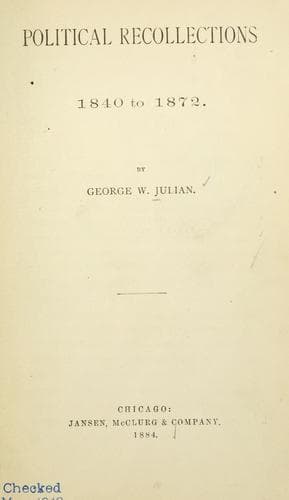
Political Recollections: 1840 to 1872Julian, George Washington
History
Political Recollections: 1840 to 1872
Julian, George Washington
Republican Party (U.S. : 1854- ) -- History; United States -- Politics and government
When President Pierce was inaugurated, on the fourth of March,
1853, the pride and power of the Democratic party seemed to be at
their flood. In his inaugural message he expressed the fervent
hope that the slavery question was "forever at rest," and he
doubtless fully believed that this hope would be realized. In his
annual message, in December following, he lauded the Compromise
measures with great emphasis, and declared that the repose which
they had brought to the country should receive no shock during his
term of office if he could avert it. The anti-slavery element in
the Thirty-third Congress was scarcely as formidable as in the
preceding one, though there were some accessions. Benjamin F. Wade
was now in the Senate, and De Witt of Massachusetts, Gerrit Smith
of New York, and Edward Wade of Ohio, were members of the House.
In the beginning the session gave promise of a quiet one, but on
the twenty-third of January the precious repose of the country, to
which the President had so lovingly referred in his message, was
rudely shocked by the proposition of Senator Douglas to repeal the
Missouri compromise. This surprising demonstration from a leading
friend of the Administration and a champion of the compromise
measures marked a new epoch in the career of slavery, and rekindled
the fires of sectional strife. After a very exciting debate in
both houses, which lasted four months, the measure finally became
a law on the thirtieth of May, 1854. It was a sprout from the
grave of the Wilmot proviso; for if, under the Constitution, it
was the duty of Congress to abandon the policy of restriction in
1850, and provide that Utah and New Mexico should be received into
the Union, with or without slavery, according to the choice of
their people, the Missouri compromise line should never have been
established, and was a rock of offense to the slave-holders. The
Compromise Acts of 1850 had not abrogated that line, and related
only to our Mexican acquisitions; but they had affirmed a principle,
and if that principle was sound, the Missouri restriction was
indefensible. The whole question of slavery was thus reopened,
for the sacredness of the compact of 1820 and the wickedness of
its violation depended largely upon the character of slavery itself,
and our constitutional relations to it.
Public-domain text, read in full here on John Shaqi.
Reviews
Reviews
No reviews yet
Be the first to share your thoughts on this work.
Elsewhere in the archive
Join the Discussion
Join the discussion
Sign in to leave a comment or review.
Sign InorCreate an account