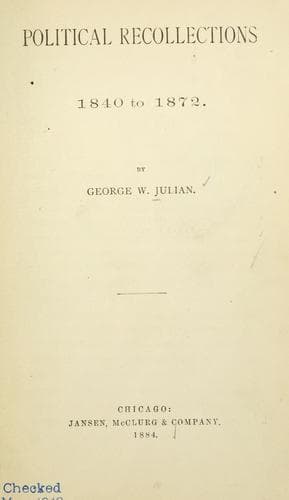
Political Recollections: 1840 to 1872Julian, George Washington
History
Political Recollections: 1840 to 1872
Julian, George Washington
Republican Party (U.S. : 1854- ) -- History; United States -- Politics and government
But Buchanan triumphed. The baleful interposition of Know-Nothingism
stood in the way of that union of forces which the situation
demanded, and was thus chiefly responsible for the Republican
defeat. The old Whigs who had so recently stepped from their
"finality" platform, could not be unitedly rallied, and the Democratic
bolters were only half converted. In my own State the opposition
to the Democracy repudiated even the name Republican, and entered
the field as "the People's party." It was a combination of
weaknesses, instead of a union of forces. All the Fillmore Know-
Nothings and Silver-Grey Whigs of the State were recognized as
brethren. At least one man on the State ticket, of which Oliver
P. Morton was the head, was a Fillmore man, while both Fillmore
and anti-Fillmore men had been chosen as delegates to Philadelphia
and electors for the State. The political managers even went so
far as to suppress their own electoral ticket during the canvass,
as a peace-offering to old Whiggery and Know-Nothingism, while the
admission of Kansas as a free State was dealt with as the sole
issue, and border ruffian outrages and elaborate disclaimers of
"abolitionism" were the regular staple of our orators, who openly
declared that the Republican party was a "white man's party." Anti-
slavery speakers like Clay and Burlingame were studiously kept out
of Southern Indiana, where the teachings of Republicanism were
especially needed, and Richard W. Thompson, then the professed
champion of Fillmore, but in reality the stipendary of the Democrats,
traversed that region on the stump, denounced the Republicans as
"Abolitionists," "disunionists," and "incendiaries," and was
everywhere unchallenged in his course. Similar tactics, though
not so deplorably despicable, prevailed in several of the other
States, giving unmistakable evidence of the need of a still further
and more thorough enlightenment of the people as to the spirit and
aims of slavery. In the light of these facts, I was not at all
cast down by the defeat of Fremont. He was known as an explorer,
and not as a statesman. If he had succeeded, with mere politicians
in his cabinet, a Congress against him, and only a partially
developed anti-slavery sentiment behind him, the cause of freedom
would have been in fearful peril. The revolution so hopefully
begun might have been arrested by half-way measures, promoting the
slumber rather than the agitation of the truth, while the irritating
nostrums of Buchanan Democracy, so necessary to display the
abominations of slavery, would have been lost to us. The moral
power of the canvass for Fremont was itself a great gain,
notwithstanding the cowardice of some of its leaders. The Republican
movement could not now go backward, and with a probation of four
years to prepare for the next conflict, unembarrassed by the
responsibilities of power, and free to profit by the blunders and
misdeeds of its foe, it was pretty sure of a triumph in 1860.
Public-domain text, read in full here on John Shaqi.
Reviews
Reviews
No reviews yet
Be the first to share your thoughts on this work.
Elsewhere in the archive
Join the Discussion
Join the discussion
Sign in to leave a comment or review.
Sign InorCreate an account