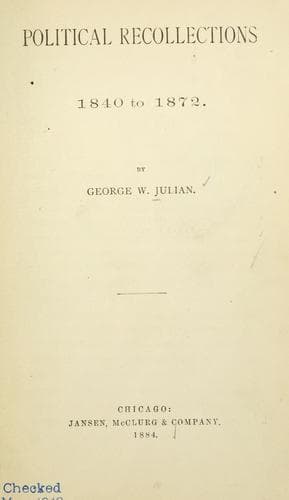
Political Recollections: 1840 to 1872Julian, George Washington
History
Political Recollections: 1840 to 1872
Julian, George Washington
Republican Party (U.S. : 1854- ) -- History; United States -- Politics and government
The Republicans, however, were sorely disappointed by their defeat;
but this second great victory of slavery did not at all check the
progress of the anti-slavery cause. It had constantly gathered
strength from the audacity and recklessness of slave-holding
fanaticism, and it continued to do so. On the 6th of March, 1857,
the Supreme Court of the United States harnessed itself to the car
of slavery by its memorable decision in the case of Dred Scott,
affirming that Congress had no power to prohibit slavery in the
Territories, and, inferentially, that the Constitution carried with
it the right to hold slaves there, even against the will of their
people. The point was not before the court, and the opinion of
Chief Justice Taney was therefore purely extra-judicial. It was
simply a political harangue in defense of slavery. It created a
profound impression throughout the free States, and became a powerful
weapon in the hands of Republicans. It was against the whole
current of adjudications on the subject, and they denounced it as
a vile caricature of American jurisprudence. They characterized
it as the distilled diabolism of two hundred years of slavery,
stealthily aiming at the overthrow of our Republican institutions,
while seeking to hide its nakedness under the fig-leaves of judicial
fairness and dignity. They branded it as the desperate attempt of
slave-breeding Democracy to crown itself king, by debauching the
Federal judiciary and waging war against the advance of civilization.
Their denunciations of the Chief Justice were unsparing and
remorseless; and they described him as "pouring out the hoarded
villainies of a life-time into a political opinion which he tried
to coin into law." When Senator Douglas sought to ridicule their
clamor by inquiring whether they would take an appeal from the
Supreme Court of the United States to a town meeting, they answered:
"Yes, we appeal from the court to the people, who made the
Constitution, and have the right, as the tribunal of last resort,
to define its meaning." Nothing could more clearly have marked
the degradation to which the power of slavery had reduced the
country than this decision, and no other single event could have
so prepared the people for resistance to its aggressions. It was
thoroughly cold-blooded in its letter and spirit, and no Spanish
Inquisitor ever showed less sympathy for his victim than did the
Chief Justice for the slave.
Public-domain text, read in full here on John Shaqi.
Reviews
Reviews
No reviews yet
Be the first to share your thoughts on this work.
Elsewhere in the archive
Join the Discussion
Join the discussion
Sign in to leave a comment or review.
Sign InorCreate an account