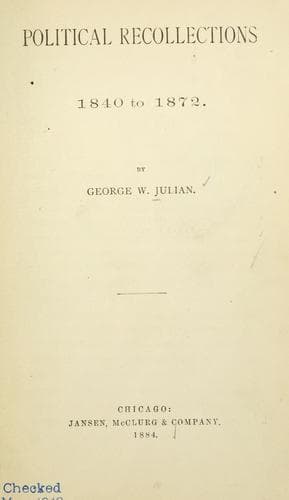
Political Recollections: 1840 to 1872Julian, George Washington
History
Political Recollections: 1840 to 1872
Julian, George Washington
Republican Party (U.S. : 1854- ) -- History; United States -- Politics and government
The Republican party gathered fresh courage and strength in the
year 1858 from the defection of Douglas. His unmistakable ability
and hitherto unquestioned devotion to slavery had singled him out
as the great leader and coming man of his party. He was ambitious,
and by no means scrupulous in his political methods. The moral
character of slavery gave him not the slightest concern, ostentatiously
declaring that he did not care whether it was "voted up or voted
down" in the Territories, and always lavishing his contempt upon
the negro. He was the great champion of popular sovereignty, but
at the same time fully committed himself to the decision of the
Supreme Court of the United States, whatever it might be; and after
that decision had been given, and, in effect, against his particular
hobby, he defended it, while vainly striving to vindicate his
consistency. But the Lecompton swindle was so revolting a mockery
of the right of the people of Kansas, that his own Democratic
constituents would not endorse it, and he was obliged, contrary to
his strong party inclinations, to take his stand against it. It
was an event of very great significance, both North and South, and
gave great comfort to anti-slavery men of all shades of opinion;
but it brought with it, at the same time, a serious peril to the
Republican party.
His accession to the Anti-Lecompton ranks was deemed so important
that many leading Republicans, of different States, thought he
should be welcomed and honored by the withdrawal of all party
opposition to his re-election to the Senate. They argued that in
no other way could the despotic power of the Democratic power be
so effectually broken, and the real interests of republicanism
advanced. This feeling, for a time, prevailed extensively, and
threatened to put in abeyance or completely supersede the principles
so broadly laid down in the national platform of 1856. The "New
York Tribune" took the lead in beating this retreat. It sympathized
with Douglas to the end of his canvass, and in connection with
kindred agencies probably saved him from defeat. It urged the
disbanding of the Republican party, and the formation of a new
combination against the Democrats, composed of Republicans, Douglas
Democrats, Know-Nothings, and old Whigs, but without any avowal of
principles. It proposed that by the common consent of these parties
the Republicans should be allowed to name the next candidate for
the Presidency, and the other parties the candidate for the Vice
Presidency; or that this proposition should be reversed, if found
advisable, with a view to harmony. The different wings of this
combination were to call themselves by such names and proclaim such
principles in different States and localities as might seem to them
most conducive to local success and united ascendancy. This
abandonment of republicanism was likewise favored by such papers
as the "Cincinnati Gazette," which pronounced the policy of
Public-domain text, read in full here on John Shaqi.
Reviews
Reviews
No reviews yet
Be the first to share your thoughts on this work.
Elsewhere in the archive
Join the Discussion
Join the discussion
Sign in to leave a comment or review.
Sign InorCreate an account