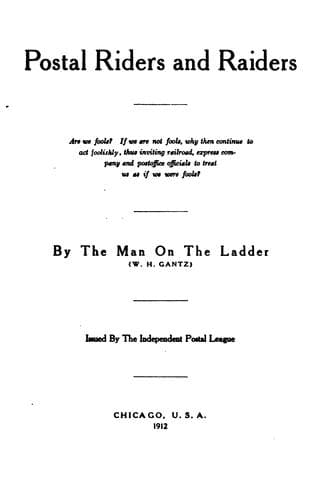
Postal service -- United States -- Second-class matter
There can be no question that there is a large number of such alleged
periodicals which have been issued and distributed through the mails
for the _plainly_ manifest purpose of advertising the merchandise of
those who pay for publishing them. I believe, however, that there are
fewer of such fake periodicals enjoying the mail service at second-class
rates today than there were ten or fifteen years ago. The Postoffice
Department, it must be said to its credit, has “disciplined” a large
number of them out of existence or, at any rate, out of the second-class
mail rate privilege.
But even if there are more of such fraud and fake periodicals today than
formerly, any fair-minded man must agree that it is a very rank injustice
to punish--to penalize by harsh restrictions and increased mailing
rates--the thousands of legitimate and highly serviceable periodicals for
the sins of a comparatively few alleged publications which have abused or
are abusing the second-class mail rate privilege.
The department, with its large force of inspectors and investigators,
should be able to weed out and exclude such “fixed” periodicals. If
it cannot do so it appears to The Man on the Ladder that it would not
require a very large amount of industrious, strenuous thinking on the
part of six robust, competent legislators to frame a law that would reach
the _guilty_ without punishing or crippling the innocent.
2. This commission was also, it would appear, a stickler over
_compliance_ with the postal statutes--statutes (those now largely
governing) enacted in 1879 and 1885, therefore so antiquated in their
wording in several particulars as to be a misfit when attempt is made to
apply them to the vast business and varied character of periodicals today.
The statute of March 3, 1879, in its definition of what the law would
recognize as a periodical says, among other things, that a periodical
must be “_originated and published for the dissemination of information
of a public character, or devoted to literature, the arts, sciences, or
to some industry_.”
This portion of the statutory definition the Commission seems to have
entertained a special grudge against. At any rate it expatiated at
considerable length in its report, against the inadequacy, lack of
definiteness, etc., of the definition as given. The commission’s chief
objection seems to center around the fact that space in periodicals
should not be devoted to “commercial ends.”
On page 35 of the report the commission says:
“What was in the mind of the author (of the 1879 statute), is
clear enough. He wished to prohibit the misuse of the privileges
for _commercial ends_ as distinguished from the devotion to
literature, science, and the rest.”
Public-domain text, read in full here on John Shaqi.
Reviews
Reviews
No reviews yet
Be the first to share your thoughts on this work.
Elsewhere in the archive
Join the Discussion
Join the discussion
Sign in to leave a comment or review.
Sign InorCreate an account