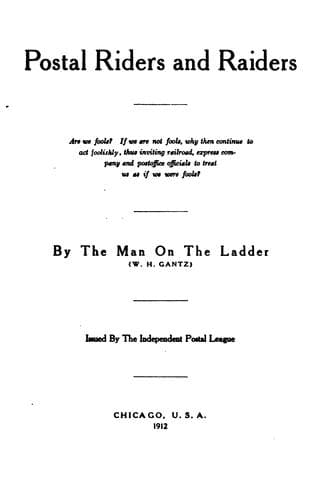
Postal service -- United States -- Second-class matter
Will some one whose thought-dome and _pockets_ are not full of ulterior
motives and postal service “deficits” please rise and answer?
Returning to the 1906-7 commission’s agony over the definition in the
act of 1879 of what should be considered a periodical and, therefore,
entitled to mail entry as second-class matter, it appears that the
commissioners, in an apparent _anxious_ anxiety to prove their charge
against the author of the act for careless, ambiguous wording, quote a
lawyer’s opinion, or part of such opinion, in support of the carefully
framed-up “arguments” which it presents in didactic order, both before
and after the quotation.
The quotation, it should be noted, is from the brief of the Postmaster
General’s counsel in Houghton vs. Payne, 194 U. S. 88, or so the
commission’s report designates it.
The point of the commission’s argument appears to be: (1) that owing to
its loose, indefinite wording, the act of ’79 was of easy evasion when
it came to passing upon the kind and character of matter which might
be published in periodical form and mailed at second-class rates, and
(2) that, by reason of such loose and indefinite wording, periodical
publishers _have_ evaded the intent and purpose of the act--have abused
their second-class rate privileges--_have violated the law_.
That, at any rate, I read as the point and purpose of the commission’s
somewhat labored, if not strained, argument. They quote (pages 37-38)
this counsel in support of that argument. I shall here reprint that
quotation as evidence that the publisher of “the universally recognized,
commonly accepted, and perfectly well understood periodical of everyday
speech” (see fifth paragraph of quotation) _have not violated the law nor
sought to do so_.
The quoted opinion presents some italicized words, phrases and clauses
as it appears in the report. I have taken the liberty to further
italicize in reprinting it:
Public-domain text, read in full here on John Shaqi.
Reviews
Reviews
No reviews yet
Be the first to share your thoughts on this work.
Elsewhere in the archive
Join the Discussion
Join the discussion
Sign in to leave a comment or review.
Sign InorCreate an account