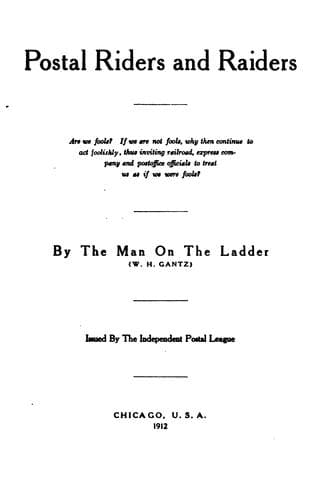
Postal service -- United States -- Second-class matter
On the other hand, a review or a magazine may be said to be
devoted to literature with perfect naturalness and propriety.
For we rightly conceive of the review or magazine as one
definite recognizable entity--a continuing whole, originated for
a given purpose, and made up of similar parts having a common
object--literature, for example, or art, or science, or whatever
else it is to which the whole is devoted.
Taking these words, originated and published for, dissemination,
information, devoted to, they all point to one conclusion.
They are, we repeat, strong and pregnant words. There is but
one concept consistent with them all. We confidently submit
that an attentive reading of the statute will leave no doubt
that what Congress constantly had in mind in the creating of
this privileged class of publications was the _universally
recognized, commonly accepted, and perfectly well understood
periodical of everyday speech_.
In establishing the rate for newspapers and other periodical
publications Congress was not seeking to discriminate between
good literature and bad literature or to establish a _censorship
of the press with prizes for merit_. The thing it had in mind
was not the goodness or badness of the information disseminated,
but the _instrumentalities by which that dissemination might
be accomplished_. It was not thinking of all the accumulated
stores of sound and pure literature in the vast libraries of the
world, _but it was thinking of how the mind of an inquiring and
progressive people might be kept abreast of the times in all
departments of human thought and activity_. Congress did not
stand hesitating between a good book and a bad newspaper.
Another position taken by the Penrose-Overstreet Commission, and one
which The Man on the Ladder strongly opposes, is that a periodical may
not or “must not consist wholly or substantially of fiction.”
The words just quoted are exactly the words used in the sixth paragraph
of Section 2 of the bill the enactment of which this commission
recommended.
Now, whatever their wit or wisdom, their eloquence or adroitness of
speech, their beauty of shape and apparel, or their loftiness of
position, that “recommendation” should recommend the personnel of that
commission, it seems to me, to some “wronghouse” for a long rest. Their
conclusion, their _lex_ recommendation and their “argument” in support,
taken collectively, are as thrilling, likewise amusing, as the point in
a story “where the woman is turned on and begins to short circuit the
hero,” putting it as near as I can remember in the language of Sewell
Ford, Bowers, or some other “enlivening writer.”
Public-domain text, read in full here on John Shaqi.
Reviews
Reviews
No reviews yet
Be the first to share your thoughts on this work.
Elsewhere in the archive
Join the Discussion
Join the discussion
Sign in to leave a comment or review.
Sign InorCreate an account