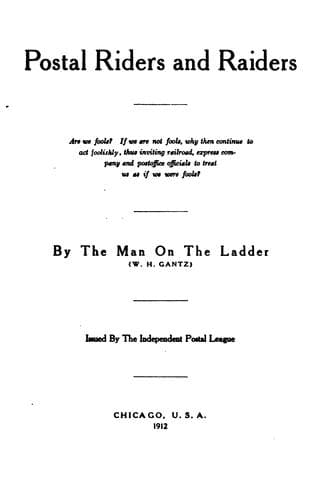
Postal service -- United States -- Second-class matter
“No fiction necessarily involves the element of periodicity
or time publication which is involved in the very idea of a
newspaper or periodical. It follows, then, (7) _that the real
purpose of the act of March 3, 1879, namely, the diffusion in the
quickest possible way at the smallest possible cost of timely
information among the people, is perverted when the right to
that quick and inexpensive diffusion is extended to the form
of fiction_. But the periodical form devoted to fiction, or in
which fiction constitutes the predominant feature, is the very
form of periodical which serves to swell the second class. The
popular demand for fiction seems to be practically unlimited.
The temptation offered by the low postal rate to supply that
demand through the periodical form is a temptation impossible to
resist.” (Page 39.)
I shall make my comment on the foregoing in the order that its italicized
_assertions_ are numbered.
(1) The “element of fiction” has not and does _not_ constitute “the
propulsive force” stated. Was it “fiction” that propulsed the circulation
of _Everybody’s_? of _Pearson’s_? of _The Cosmopolitan_? of _The
American_? of _McClure’s_? of _The Saturday Evening Post_? of _The Inland
Printer_? of _The Progressive Printer_? or of scores of other monthly
and weekly periodicals whose publishers are independent enough to do
their own thinking and courageous enough to publish what they and their
representatives found to be the truth?
Was “Frenzied Finance” fiction?
Was Anna M. Tarbell’s exposures of Standard Oil fiction?
Was the exposure of the Waters-Pierce Oil Company’s connection with
the great Senatorial “I” of Texas fiction? Was the shake-up of the “Big
Three” life insurance companies fiction? Were the hundreds of other
trenchant write-ups and exposures of wrong practices, of impositions,
of crookedness and _crooks_ in official, corporation and private life,
“fiction?”
The man who reads and will attempt to answer any of those questions
affirmatively needs to have his brain dusted up--that is, of course, on
the presumption that he is not _paid for vocal gyrations_.
And yet it was the telling write-ups and exposures of these independents
which greatly increased their circulation and, consequently, increased
second-class tonnage.
(2) There is no such “main statutory check.” Moreover, the “commercial
exploitation” given in the advertising pages of our standard periodicals
to merchants, manufacturers, etc., is, as previously shown, not only just
and due to the vast commercial interests of the country, but it is safely
within both the letter and the intent of the statute.
Public-domain text, read in full here on John Shaqi.
Reviews
Reviews
No reviews yet
Be the first to share your thoughts on this work.
Elsewhere in the archive
Join the Discussion
Join the discussion
Sign in to leave a comment or review.
Sign InorCreate an account