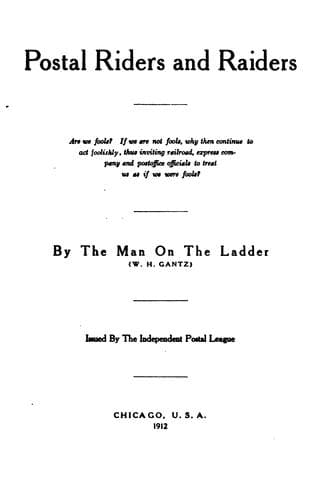
Postal service -- United States -- Second-class matter
1. Much--yes, most--of the fiction printed during recent years in our
standard periodicals (even in those printing only fiction as “body
matter”), has been highly didactic or educational in character.
2. The periodical fiction published in our leading magazines and weeklies
has taught our people lessons in morals, in politics, in political
economy, in social, domestic and industrial life. It has told its
readers of the habits and habitat of animals, of birds and bees; of
flowers, of fruits and forestry. Nor has there been much of “nature
faking” in it. Some of the most informative matter ever printed bearing
upon natural history, the geography, topography and hydrography of this
earth, has reached us through the periodical fiction of the past ten
or twelve years. Not only that, but such fiction has gone to the farm
and into the laboratory, into the mine, the factory, the mill, and the
lumber camp; into the mercantile establishment, into transportation,
both rail and water; into the counting room, into the “sweat-shop” and
into the tenement districts, the purlieus and the “submerged tenths” in
both the lower and higher “walks” of the world’s various and varying
civilizations, and it has _taught us things_ we did not before know.
Then _why_ should new laws be enacted, or old laws be twisted, turned
or misconstrued, to exclude “fiction”--_periodical_ fiction--from the
second-class mail rate privilege?
One other objection I find to this 1906-7 commission’s report. It
recommends the appointment of a “Commission of Postal Appeals.”
The report states that certain publishers favored such a commission.
That be as it may, I do not believe that such a commission will return
service value at all commensurate with the amount of public money
it would cost to keep its wheels “greased” and operating. Next to a
bureaucracy, government by commissions is the worst. Can the reader think
of a “Commission”--a Government, a State, County or City Commission--that
ever discharged, promptly and satisfactorily, the duties assigned to it?
One is put to no trouble to think of scores of Civil Service Commissions,
Forestry Commissions, Subway Commissions, Canal Commissions, Traction
Commissions, Railroad Commissions, Postal Commissions, Inter-State
Commerce Commissions and a host of others.
But do you know of one of them that ever did any real serviceable work
_for the people_--did it until an aroused and hostile public opinion
_kicked_ it into doing the work?
You may know of one. The Man on the Ladder knows of _none_, and he has
been watching the service value of the “commission” for thirty-five
years. As a _governing_ instrument it has largely been a _subversive_
instrument. It always spends its appropriation. It always puts as many
of its uncles, brothers and nephews on the pay roll and takes as many
junkets as is possible under its appropriation and, if the appropriation
is exceeded, it usually asks for more and--_gets it_.
Public-domain text, read in full here on John Shaqi.
Reviews
Reviews
No reviews yet
Be the first to share your thoughts on this work.
Elsewhere in the archive
Join the Discussion
Join the discussion
Sign in to leave a comment or review.
Sign InorCreate an account