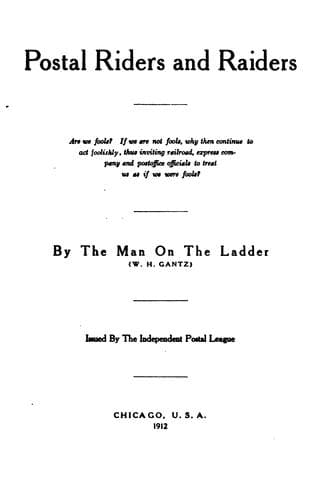
Postal service -- United States -- Second-class matter
But from this figure of 343,760,000 pounds the Postmaster
General would have to subtract the weight of all the periodicals
exempted, and also subtract all the new expense involved for a
large force of clerks.
There will also be a great increase of work for inspectors, as
the proposed measure puts a premium on dishonesty. There will be
constant temptation for unscrupulous people, who try to take the
place of the present reputable publishers, to publish advertising
in the guise of legitimate reading matter. There will be extra
legal expenses for the disputes that arise between publishers and
the Postoffice Department over matters in which the publishers
may believe the department is using the despotic power given by
this measure to confiscate the property of publishers. In the
hearings before the Weeks committee, it was frankly admitted by
members of the House Committee on Postoffices and Postroads that
the government postoffice service could never be run with the
economy and efficiency of a private concern.
With all the expense of this new scheme subtracted from such a
small possible gain as is claimed by Mr. Hitchcock, what revenue
would remain to justify the wiping out of an industry built up in
good faith through thirty-two years of an established fundamental
postoffice rate?
If the department succeeded in saving $2,000,000, after deducting
the exempted publications and all the new expense involved for a
great force of clerks, this would amount to less than 1 per cent
of its revenues for 1910. It would amount to less than one-eighth
of the postoffice deficit in 1909. It would amount to less than
one-fourteenth of the loss on rural free delivery alone in that
year.
But even this gain would be only theoretical; for, as shown
before (Exhibit A), many of the comparatively small groups of
periodicals left to be published, after the favored ones were
exempted, would find that it required more than all their income
to pay their share of the new rate.
You can not take away from a person more than 100 per cent of all
that he has--even from a publisher. It is not there.
These figures of increased revenue to the government are based on
the department’s own statements. They are mathematically accurate.
They must not be interpreted, however, as measuring the extent
of publishers’ losses. They take no account of the increases,
certain to follow the enactment of this legislation, in the rates
of other lines of distribution from which the government derives
no revenue. They take no account of the loss in circulation
volume, that is certain to follow an attempt to raise the price
of magazines to the public. They take no account of the loss
in advertising revenue that is certain to follow a loss in
circulation.
Public-domain text, read in full here on John Shaqi.
Reviews
Reviews
No reviews yet
Be the first to share your thoughts on this work.
Elsewhere in the archive
Join the Discussion
Join the discussion
Sign in to leave a comment or review.
Sign InorCreate an account