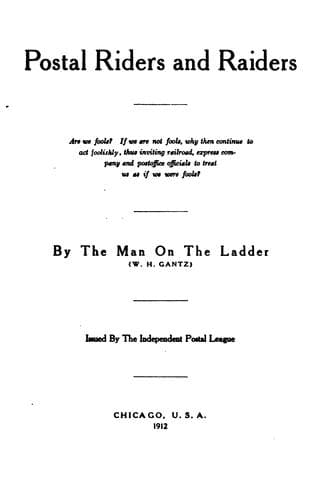
Postal service -- United States -- Second-class matter
We have devoted most of our previous space to Mr. Hitchcock’s “rider,”
to the influences and _influencers_ that originated it and tried to
push it--by methods adroit and scrupulously unscrupulous--into federal
enactment--into operative law. At this point of our presentation of
the general subject of Postal Riders and Raiders, it was my original
intention to take up generally the _raider_ features or elements as
planned for discussion in this volume. I intended to start just here to
discuss the Postoffice Department “deficit,” of which Mr. Hitchcock has
had so much to say--and of which he made voluminous and eloquent use
during his efforts to bring his “rider” a safe winner under the wire. I
intended, as just said, to begin to write about the postal “deficit” just
here--a deficit _which never had real existence_, since the days of the
“pony post” and “mail coach,” save in quasi form--in methods covering
political lootage and looters.
Well, I have changed my original plan a little. I’ll run a few lines
through that “deficit”--twaddle-talk, a little further on. Here I will
merely repeat what I have already said, in substance at least.
There never has been a postal deficit since the period I have indicated,
save deficits created by official crooks and crookedness, by “interests”
which _hired_ the official crooks and bought the crookedness, and by
department accounting methods which would put Standard Oil or a Western
cow ranch on the financial blink inside of thirty-six months, or even in
twelve.
We will discuss this artistic “deficit” later. Here I now desire to
advert to, and animadvert on, another point which has been brought
forcibly to my attention recently--weeks, some two months, after I
climbed up here to take a look over the general situation, and then
chanced, through the aid of a Congressman friend, to get my distance
glasses focused on this postoffice foolery.
Foolery, I have written. I was wrong. There was no foolery about it. It
was a _calculated, a studied, a cold-blooded partisan stab at one of the
greatest and most helpful--most up-building--industries in this country_.
But we will let that point and the “deficit” rest for the present. It
appears that one of Mr. Hitchcock’s much-worked arguments to harvest or
glean votes for his rider amendment was that the amendment would “affect
only a few magazine publishers,” or that “only a few magazine publishers,
at most, would be affected by the amendment and that they had _enriched_
themselves by the special privilege granted by the second-class mail rate
statute of 1885,” etc., etc.
Various newspapers quoted Mr. Hitchcock variously on the same point or
to the same end, and two Congressmen acquaintances reported that he had
personally talked to them along the same lines.
Public-domain text, read in full here on John Shaqi.
Reviews
Reviews
No reviews yet
Be the first to share your thoughts on this work.
Elsewhere in the archive
Join the Discussion
Join the discussion
Sign in to leave a comment or review.
Sign InorCreate an account