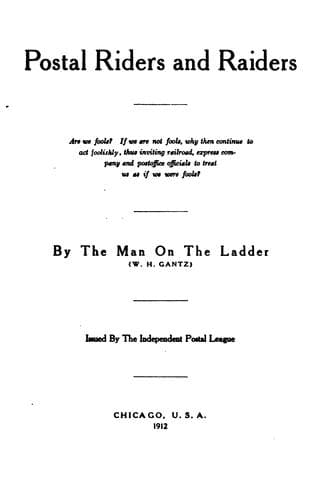
Postal service -- United States -- Second-class matter
For this he merits our highest praise and commendation.
Personally I yield it to him, untrammeled and in full meed. I
object only to his attempt to saddle upon second-class mail--the
one-cent-a-pound-matter--the burden of recouping the government for
the losses on rural route and star route service and the railway mail
pay stealage. I object because I not only believe, but I _know_ as
comprehendingly and as comprehensively as does he, that the second-class
matter carried in the mails today at one cent a pound _should be carried
and handled at a profit at that rate_.
I also know that just as second-class mail (periodicals), is cut down in
distribution _in just about the same proportion will the revenue from
first, third and fourth class mail be cut down_.
It is because of this firm belief, that I oppose Mr. Hitchcock’s, to me,
absurd purpose and attempt to make “each division or class of mail pay
for its carriage and handling.”
I am also opposing his manifest attempt to “play favorites” in
legislation and to secure bureaucratic powers for his department--in
contravention of my constitutional rights--to _your_ constitutional
rights.
I take the following from the New York Call of August 26. The Call
captions it as “Hitchcock’s Sum Up.” It evidences the fact that he still
follows his folly--that he is still after those “few magazine publishers”
and after them, too, on his “rider” lines.
The Call reports as follows:
“The attorneys for the magazines,” said Postmaster Hitchcock in
summing up the government’s case, “have presented this matter
of advertising in magazines in such a way as to leave the
impression that there is a controversy over it. There is none.
_The department knows that the advertising matter in magazines
produces first-class mail_ and that the postoffice is benefited
in that way. The important question is: What effect will a whole
increase of 1 cent a pound have on the advertising? Will it be
the means of stopping it?
“We feel that advertising would not be diminished by such an
increase and if such is the case, all this information which
we have heard today, interesting as it may be, is not to the
point. Repeatedly we have heard the general argument against an
increase in rates as though our recommendation is for a general
increase. We don’t want that at all. What we are driving at is a
readjustment. We are not trying to economize or save money. We
have done that to the best of our ability already and want simply
to increase the second-class rate so that the first will pay for
itself, believing that in this way the greater number of people
will be served.”
Public-domain text, read in full here on John Shaqi.
Reviews
Reviews
No reviews yet
Be the first to share your thoughts on this work.
Elsewhere in the archive
Join the Discussion
Join the discussion
Sign in to leave a comment or review.
Sign InorCreate an account