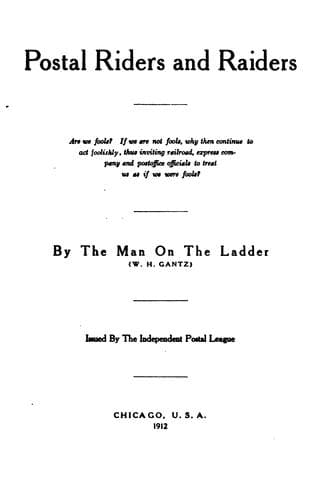
Postal service -- United States -- Second-class matter
I go back still further to 1876 when the postage rate on
newspapers was 4 times greater than now, when the sale of stamps
was less than one-eleventh what it is now, _and while deficits
were larger_.
The highest point reached in the weight of second-class matter
previous to the institution of the present rate, was 101,057,963
pounds.
It has been repeatedly declared officially that second-class
matter originates large quantities of other classes of mail, and
in the official figures we have the proof.
While population increased from 1885 to 1910 only a little more
than double, the revenue from the sale of stamps, etc., and the
weight of second-class matter, each increased over 5 times. _No
other possible reason can be assigned for the increase in stamp
mail, and the tremendous development of every branch of the
postal business 5 times faster than the growth of population,
than the increased circulation and influence of the newspaper and
periodical press, brought about by the reduced postage rate._
SECOND-CLASS MATTER WOULD HAVE LONG AGO WIPED OUT ALL DEFICITS
AND CREATED AN ENORMOUS ANNUAL SURPLUS HAD IT NOT BEEN FOR THE
GREAT BURDENS WHICH WEIGHED THE SERVICE DOWN.
There would have been a surplus, instead of a deficit, every year
since 1901, had allowance been made for the extraordinary cost
of free rural delivery, and in 1910, the surplus would have been
$31,075,170.12.
If also allowance had been made for free government matter, other
than the Postoffice Department’s own free matter, being sent
stamped as first-class matter is, the surplus for 1910 would have
been $51,075,470.12 and these figures like all others here given,
are from official reports.
A VAST INCREASE OF EXPENDITURES.
_Not only did stamp mail, under the stimulus of the steady and
enormous increase of second-class matter, enable the Department
to meet the cost of rural delivery while reducing the deficit,
but it also met and overcame the immense increase of the annual
expenditures for railroad transportation which grew from
$33,523,902.18 in 1901 to $44,654,515.97 in 1910: of salaries to
postmasters, assistants and clerks which grew from $32,790,253.39
in 1901 to $65,582,533.57 in 1910, of the railway mail service
which grew from $9,675,436.52 to $19,385,096.97 in 1910, and of
the city delivery service which grew from $15,752,600 in 1901
to $36,841,407.40 in 1910. In these four items alone there was
an increase in annual expenditures in the last ten years of
$74,721,361.82, for which second-class matter was only in a very
limited way responsible._
Public-domain text, read in full here on John Shaqi.
Reviews
Reviews
No reviews yet
Be the first to share your thoughts on this work.
Elsewhere in the archive
Join the Discussion
Join the discussion
Sign in to leave a comment or review.
Sign InorCreate an account