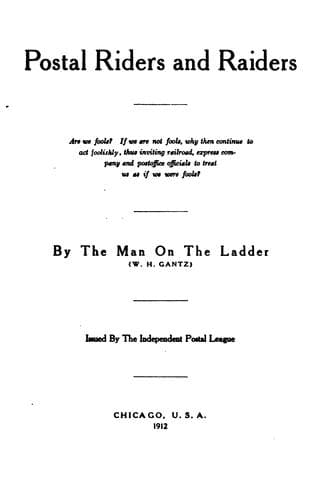
Postal service -- United States -- Second-class matter
President Woll dwelt on the far-reaching effect which the
hampering of the labor press would have on the manifold business
relationships involved in the printing industry, primarily
directing attention to the more than a third of a million of
workers in the printing trades alone. He then advanced to
the foundation of the paper and machinery features of the
proposition, viz., from the ore in the mine, from which the
machinery was made, to the forest tree from which the pulp is
ground. The tonnage of the transportation service of the country
would at once be doubly interfered with, first in a reduced
demand for material with which to make the paper and, secondly,
the corresponding decrease in the weight of the finished product
of the publications. In many features Mr. Woll made prominent
the ideas which the “Postal Riders and Raiders” is promoting,
including the educational features of the immense volume of
printing which comes from the printing press in all sections of
the country.
The commission adjourned, subject to the call of Justice Hughes.
However, it is understood that it will be called together in time
to prepare its report to President Taft and to Congress when the
session opens in December, 1911.
FOOTNOTES
[6] Mr. Hitchcock, it should be noted, is careful in giving the higher
per cent. of rate which the third and fourth classes show above the
second class rate. Beyond the bare statement that the expense of handling
second class matter “is less” than for other classes, he says nothing
of cost of carriage and handling. His own figures show (see preceding
paragraph), that the cost of carriage and handling first-class matter is
422 per cent. higher than his own absurd cost-figure of 9 cents a pound
(cost) for carriage and handling second-class and _4600 per cent. higher
than the present second class rate_.
[7] Mr. Suter must certainly have been wind-jamming a little. “Every man,
woman and child” pays at a maximum rate of 2 cents an ounce or fraction
thereof. That is at the rate of 32 cents a pound. Mr. Hitchcock’s figures
assert, that it costs “47 cents a pound” to carry and handle the letters
for “every man, woman and child”--that is, presuming they all write
letters. The letter writers, it appears then, pay only 2 cents for a
service which costs nearly 3 cents.
CHAPTER X.
POSTAL DEFICITS.
Now, let us look into and over that postoffice “deficit,” to the
origin of which the memory of man scarcely runneth back, and which Mr.
Hitchcock, by some strenuous effort on _right_ lines readily converted
into a surplus--a $6,000,000 deficit into some hundreds of thousands
of dollars surplus. The returns are not all in yet. At any rate the
Postmaster General has not announced them loud enough for The Man on the
Ladder to hear, or he was in his physician’s hands when the announcement
was made.
Public-domain text, read in full here on John Shaqi.
Reviews
Reviews
No reviews yet
Be the first to share your thoughts on this work.
Elsewhere in the archive
Join the Discussion
Join the discussion
Sign in to leave a comment or review.
Sign InorCreate an account