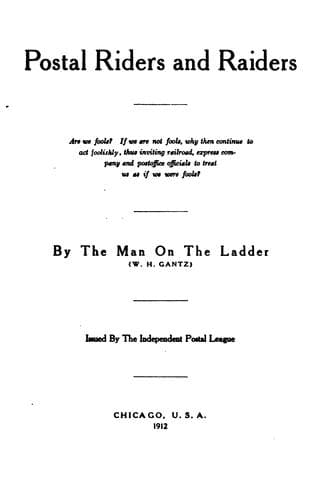
Postal service -- United States -- Second-class matter
If the patriotic citizen has been an “old soldier,” or is familiar with
the history of wars, he will also know that, if the whole land fighting
of that Spanish American war was corralled into _one_ action that action
would be infinitely less sanguine than was the action at a number of
“skirmishes” in our civil war--that, if the several naval actions of that
war were merged into one, it would not equal, in either gore or naval
glory, Farragut’s capture of Mobile, the action in Hampton Roads, nor
even Perry’s scrimmage on Lake Erie in 1813.
What has all this to do with the postal department deficit, some one may
ask? It has just this to do with it:
If a people stand unmurmuringly for the expenditure of _billions_ for
a service that yields them no return, save a protection _they have not
needed_ and of doubtful security if needed, that people is not going to
raise any noisy hubbub over a dinky deficit of a few millions a year for
a service which should serve them _every day of every year_.
I have expanded a little, not disgressed, in writing to my statement
numbered 3. I will now proceed with my premeditated statements. Some of
them may be a little frigid, but none of them are cold-storage. Some one
may have told it all to you before, but that is his fault, not mine. He
merely beat me to the _facts_.
4. As stated in a forward page of this volume, the people of this nation
want and demand _service_ of its Postoffice Department. They care not to
the extent of a halloween pea-shooter whether the service is rendered at
a deficit of six million or at a surplus of ten million, _if service is
rendered for the money expended_.
5. The people of this country will object more strenuously against a
_surplus_ in their postal revenues--their service tax--than they ever
have or will object to a deficit in the revenues of that service, _if
they get the service_.
6. The Postoffice Department is not understood--is not even thought of
by intelligent citizens--as a _revenue-producing_ department. It _is_
understood to be a _service_ department, and the citizen--His Majesty,
the American Citizen--is always willing to pay for services rendered.
7. The Postoffice Department has not in the period named--no, not for
thirty or thirty-five years--_rendered the citizen the service for which
he paid_.
I mean by that, of course, that the citizen has been compelled to pay far
more for a postal service than he _should have paid for that service_.
8. Had that service been _honestly, faithfully and efficiently rendered_,
the price the citizen has paid for it _would have left no deficit for any
year within the past thirty_.
9. _The only deficits in those thirty or thirty-five years have been
the result of manipulated bookkeeping, of political trenching into the
revenues of the department, of loose methods in its management, of
disinterest in the enforcement of even loose methods, and of downright
lootage and stealings._
“Rather harsh that, is it not?” asks one.
Public-domain text, read in full here on John Shaqi.
Reviews
Reviews
No reviews yet
Be the first to share your thoughts on this work.
Elsewhere in the archive
Join the Discussion
Join the discussion
Sign in to leave a comment or review.
Sign InorCreate an account