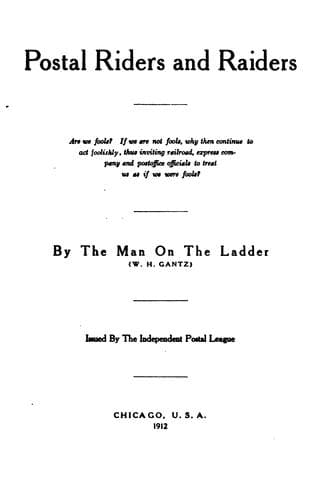
Postal service -- United States -- Second-class matter
If the owner of an Egyptian hen ranch had a shrinkage in his castor bean
crop, he would not think of charging the cost or loss on those castor
beans up to his hens, would he? Hens do not eat castor beans. That is
useless--well--yes, of course. Well, hens do not eat castor beans,
anyway. So my ill-chosen illustration, though may stand--stand anyway
until someone finds a breed of hens which likes castor beans.
But, if the hens of that hen-rancher invaded his vegetable garden,
scratched up his set onions and seeded radishes, pecked holes in three
hundred heads of his “early” cabbage and otherwise damaged the fruits
of his labor, care and hopes--likewise disarranged his figures on
prospective profits--if the hens did that, that hen-rancher would most
certainly charge his loss to the hens, would he not?
That is, he would do so, if the hens had attended to their legitimate
business as industriously as they looked after his vegetable garden and,
by reason of that legitimate effort, showed a “profit balance.” The
preceding is based, of course, on the assumption that the rancher has
acumen enough to distinguish a hen from a rooster and a sunflower from a
cauliflower. If he is so wised up, whether by experience and observation
or by academic training, he will most certainly charge his loss on
vegetables against those hens.
“What is the application of all this to the Postoffice Department
deficits?” some one is justified in asking.
Well, my intended application of it is, first, to show a generally
recognized and practical business method--a business method practiced by
both public and private corporations and by individuals and firms, from
the hen-rancher to the department store. My second purpose is to show
that this almost universally recognized business method has been and is
_totally ignored in conducting the vast service affairs_ of the Federal
Postoffice Department.
FREE-IN-COUNTY MATTER.
The 1910 report of the Postoffice Department states that 55,639,177
pounds of second-class mail was carried and distributed _free_ in the
counties of these United States.
Of course, this 1910 _gift_ to country publishers is the result of a
moss-grown custom--a custom born of an ingrown desire common to crooked
politicians--a desire to trade the general public service for _private_
service. All the second, third and fourth class cities in the country, as
well as a majority of our towns and larger incorporated villages, have
their _party_ newspaper or newspapers.
Public-domain text, read in full here on John Shaqi.
Reviews
Reviews
No reviews yet
Be the first to share your thoughts on this work.
Elsewhere in the archive
Join the Discussion
Join the discussion
Sign in to leave a comment or review.
Sign InorCreate an account