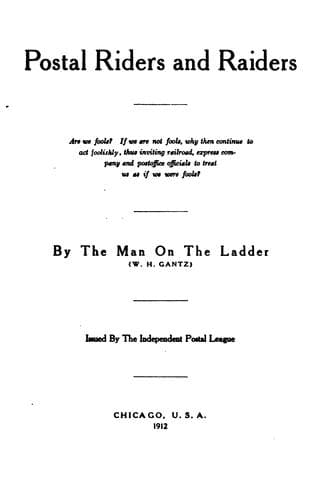
Postal service -- United States -- Second-class matter
Again, it will be observed by careful readers of the Commission’s report
that the “estimates” upon which several of its more important findings
are based, are conspicuously lacking in elements essentially necessary
in the structure of reliable estimates from which fact or facts may be
deduced. To warrant the drawing of conclusions of fact from it, the
structural material of an estimate must consist largely, if not wholly,
of fact, not of conclusions drawn from other conclusions which, in turn
were deduced from estimates based on other estimates that may or may not
have been accurate and dependable.
As just stated, the estimates which the Commission appears largely to
have accepted, are nearly all productions of the Postoffice Department.
Few of them are built directly upon ascertained facts. Most of them
are estimates of estimates based on other estimates. It appears that
the Postmaster General’s estimates are Assistant Postmaster Generals’
estimates of the estimates made by weighing clerks of the several classes
of mail-weights carried by certain railroads during six months in the
year 1908. The nearest approach such a method or procedure makes to a
fact is an estimate of the fact, you see.
A POSTAL TELEGRAPH.
One more quotation from the President’s message and this chapter may
end. This quotation is anent the proposition of having the telegraph
service of the country operated by the government--in connection with the
postal service. Mr. Hitchcock’s recommendation in the matter of a postal
telegraph “is the only one,” says the President, “in which I cannot
concur.” I shall first quote President Taft and then quote Mr. Hitchcock
as he expressed himself in his 1911 report:
This presents a question of government ownership of public
utilities which are now being conducted by private enterprise
under franchises from the government I believe that the true
principle is that private enterprise should be permitted to carry
on such public utilities under _due regulation as to rates by
proper authority_ rather than that the government should itself
conduct them. This principle I favor because I do not think it in
accordance with the best public policy thus greatly to increase
the body of public servants. _Of course, if it could be shown
that telegraph service could be furnished to the public at a
less price than it is now furnished to the public by telegraph
companies_, and with equal efficiency, the argument might be
a strong one in favor of the adoption of the proposition. But
I am not satisfied from any evidence that if these properties
were taken over by the government they could be managed any more
economically or any more efficiently or that this would enable
the government to furnish service at any smaller rate than the
public are now required to pay by private companies.
Public-domain text, read in full here on John Shaqi.
Reviews
Reviews
No reviews yet
Be the first to share your thoughts on this work.
Elsewhere in the archive
Join the Discussion
Join the discussion
Sign in to leave a comment or review.
Sign InorCreate an account