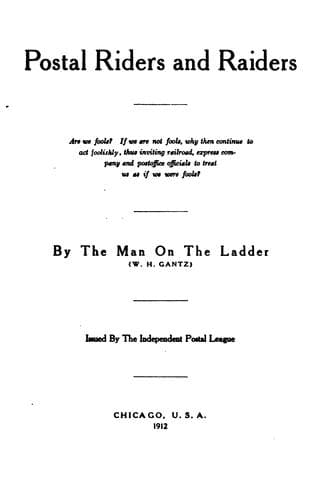
Postal service -- United States -- Second-class matter
Well, none of the before-mentioned “life lessons” could have been set
for the world’s enlightenment--likewise, disgust--had the people of this
country not waited, not made haste slowly, in “due deliberation,” while
the Western Union and other “Gould properties,” were used to separate
them from many millions of dollars which no Gould or Gould property ever
earned.
But this is digressing. The President advises us to wait, to delay action
a little longer--until the “postal savings banks have come into complete
and smooth operation,” until “after a parcels post has been established
… throughout the department.” Just wait and keep on paying twenty-five
cents for a ten-word wire to your mother or friend ten miles out, even
though the veriest fool knows that a postal telegraph service would carry
a twenty-five word message to any postoffice in the United States for
ten cents. Just keep on waiting--_until the big telegraph interests have
sheared a few millions more fleece_.
But, says President Taft, “If it could be shown that telegraph service
could be furnished to the public at a less price,” etc., etc.
Well, maybe there is a sort of visual aphasia which makes a quarter look
like ten cents to some men. If not, I am at a loss to understand how it
yet remains for anyone to be “shown” that telegraph service could be
furnished to “the public at a less price than it is now furnished by the
telegraph companies.” Postmaster General Hitchcock furnished sufficient
information, it seems to me, to show the President, or anyone else for
that matter, that telegraph service “could be furnished the public” at
rates much below those the telegraph companies collect. Mr. Hitchcock
speaks in part, as follows--page 14, 1911 report:
The telegraph lines in the United States should be made a part
of the postal system and operated in conjunction with the mail
service. Such a consolidation would unquestionably result in
important economies and permit the adoption of lower telegraph
rates. Postoffices are maintained in numerous places not reached
by the telegraph systems and the proposed consolidation would
therefore afford a favorable opportunity for the wide extension
of telegraph facilities. In many small towns where the telegraph
companies have offices, the telegraph and mail business could be
readily handled by the same employees. The separate maintenance
of the two services under present conditions results in a
needless expense. In practically all the European countries,
including Great Britain, Germany, France, Russia, Austria, and
Italy, the telegraph is being operated under government control
as a part of the postal system. As a matter of fact, the first
telegraph in the United States was also operated for several
years, from 1844 to 1847, by the government under authority from
Congress, and there seems to be good ground why the government
control should be resumed.
Public-domain text, read in full here on John Shaqi.
Reviews
Reviews
No reviews yet
Be the first to share your thoughts on this work.
Elsewhere in the archive
Join the Discussion
Join the discussion
Sign in to leave a comment or review.
Sign InorCreate an account