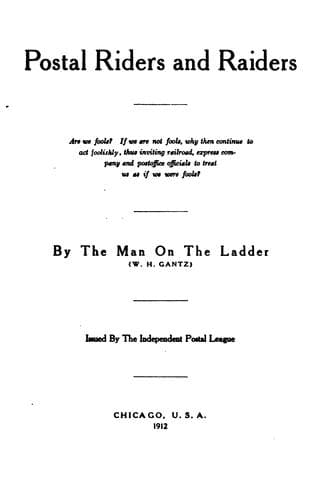
Postal service -- United States -- Second-class matter
Let us here take note what the foregoing tabulated figures mean--figures
which Mr. Kirkman argued, if I read his testimony correctly, are
too low[14]. I have read the testimony of numerous other railroad
representatives, testimony before the Loud Commission, 1898, the Wolcott
Commission, 1901, the Penrose-Overstreet Commission, 1907, and before the
Hughes Commission, whose report is not yet compiled for publication. Each
and all of them, so far as I have read their testimony, argue eloquently
that the present rates of railway mail-pay and car rentals are, if unfair
at all, unfair to the railroads--that the rates of pay are too low.
In this connection a most peculiar, if not indeed a peculiarly
suggestive, _harmony_ of opinion appears to have existed between the
special pleaders for the railroads in this matter of railway mail-pay and
government officials--both executive and legislative--who have had most
to do with fixing railway pay rates. The government has spent millions
of dollars for investigations by commissions, by Senate and House
committees, by inspectors, special agents, etc. Each commission has heard
numerously from the railways. Twenty-seven of them were in hearing before
the Wolcott Commission. The testimony of Mr. Kirkman, from whom I quote
the preceding tabulations, while varying in phase, phrase and verbiage
from the other railroad representatives, has two essential features
common to them all, or, I should say, three features common to them all.
1. The railroad representatives unanimously oppose any reduction in the
rates for railway mail pay (weights pay), and mail car rentals--“space
charge,” they call it.
2. They are a unit in declaring that the present rates are too low, but
they as unitedly express a willingness to _continue business at the old
rates_ rather than to contemplate the possibility of a reduction in them,
or even _squarely_ to argue the justice and fairness of such a reduction.
3. When forced down to “tacks”--down to specific facts--by some
interrogating member of the commission before which they are testifying,
these railroad representatives again have a marked similarity as to
“form.” Each comes eloquently forward with his _own_ set or sets of
figures and proceeds to make his _own_ application of them. But when some
commissioner asks for information and enlightenment as to “net cost,”
“relative cost,” etc., of mail carriage as compared with the cost of
express, freight or passenger handling, the railroad representatives,
almost to a man, at once begin to display a dense denseness that is
marvelously wondrous or wonderously marvelous, as the reader may choose
to word it.
Public-domain text, read in full here on John Shaqi.
Reviews
Reviews
No reviews yet
Be the first to share your thoughts on this work.
Elsewhere in the archive
Join the Discussion
Join the discussion
Sign in to leave a comment or review.
Sign InorCreate an account