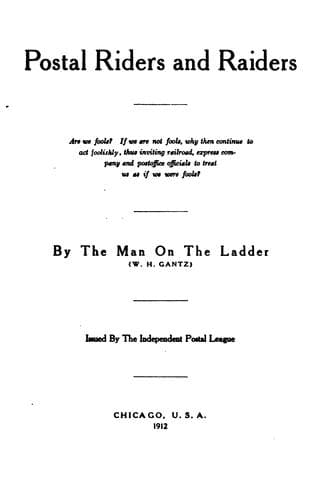
Postal service -- United States -- Second-class matter
Without questioning the veracity of the gentlemen under whose “authority”
that statement is made, The Man on the Ladder, as a judgmental
precaution, shall line up with the folks “from Missouri” until that 12
per cent is set forth in fuller relief--until he is shown. The reader
will observe that the railroad authorities quoted merely say that the
“arbitrary change of divisor further reduced the pay of the railroads.”
Whether or not the pay received by the roads _before_ that order was
issued was too low, low enough or too high is not directly stated by
the writer or writers. That it is designed to have the reader draw the
conclusion that the rate was low enough or too low before that second
order was issued is made evident by the reference to the expressed
opinions of “congressional committees”--opinions to the effect that the
“reductions” forced by the first order were “unfair.”
Third: The names of many men of both ability and of integrity have
appeared upon the rosters of the Committees on Postoffices and Postroads
of both the Senate and the House during the past forty years. In face of
that fact stands forth in bold relief a fact so bare and bald--and so
_suggestive_ of wrongs done and doing by the rail people--as to remove
it from the field of serious debate. That fact is: For forty or more
years the railroad men and allied interests have by lobbies, or other
_persuasive_ means, got the Congressional Committees (Senate, House and
joint), to do about what they wanted done in the matter of rail carriage
and pay for handling the mails, or to prevent the committees from doing
things they did not want done.
Fourth: That “change of divisor,” covered in the order of June 27, 1907,
and which these railroad men accuse of causing a shrinkage of 12 per cent
in the mail-weight pay the roads were receiving under the order of March
2, 1907, and prior, possibly was based on some valid reasons or grounds,
or upon grounds the then Postmaster General believed to be valid. I have
not before me, at the moment, any written data or information as to the
reasons assigned by the postal authorities for that “change of divisor”,
or whether they assigned any reasons for the order making the change. I
know, however, of one very good reason there was for making such a change
on several railroads or divisions of roads.
The weighing of the mails was formerly made during a period of 90 to
105 days, or fifteen weeks, once every four years. The law now permits
the Postoffice Department to make special weighings, I believe. On the
average daily mail weight for those 105 days the postal department based
its contract with the roads for carrying the mails for four years.
Now notice this: The terms of such contracts not only implied but
specifically required a _daily_ carriage of the mail weight for the
number of days designated, allowing, of course, for wrecks, washouts and
other unavoidable interruptions in the movements of trains.
Public-domain text, read in full here on John Shaqi.
Reviews
Reviews
No reviews yet
Be the first to share your thoughts on this work.
Elsewhere in the archive
Join the Discussion
Join the discussion
Sign in to leave a comment or review.
Sign InorCreate an account