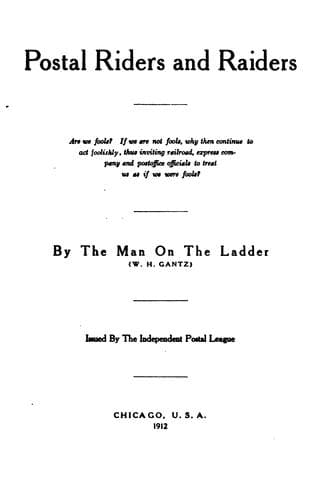
Postal service -- United States -- Second-class matter
The Postoffice Department is a large institution and does a big
business--a huge business which has much detail and extends over a vast
territory. To handle such a business properly, necessarily requires
the service of a large force of operatives. Most of the work of the
department is of that sort which human brain and muscle alone can do. The
machine can touch but a few of the minor details of the vast amount of
work our Postoffice Department handles. It may cancel stamps, perforate
documents, etc., but it cannot collect, sort, distribute, carry and
deliver mail. It requires human muscle and brains to do such work. Much
of it requires skill--the trained eye and hand as well as academic
knowledge.
Well, the Postoffice Department employs a large force--a vast army of
men, and some women, I believe. Counting the employes in its legal,
purchasing and inspection divisions with the postmasters, assistant
postmasters, railway and office clerks, city and rural carriers,
messengers, etc., there must be somewhere around 330,000 people employed
in our federal postal service.
Whether that is too large or too small a force for the _proper_ handling
of our postal service is beyond my purpose here to discuss. That the
business now handled by the department could be far better handled by
330,000 employes than it now is, and that such a service force could, if
properly directed and disciplined, handle a business much larger than
that now transacted by the department, I do not hesitate to assert. I
base that assertion chiefly on the following observed conditions:
First: There are frills and innovations in handling the business which
take up the time of employes and which have little or no service value.
Second: There is, not too much “politics,” as Mr. Hitchcock and
his immediate predecessors have modestly but wrongfully called it,
but too much political partisanship--_dirty, grafting, thieving,
partisanship_--not only in the appointment of people to the service,
but also in making partisan, often grafting, crooked use of them after
appointment.
Third: There are too many non-producers--non-service producers--among
that army of 330,000.
It is the last, or third, condition named that I shall here briefly
consider, or such observed phases of it as, in my judgment, so trench
into the postal revenues as not only amounts to a raid in itself, but
which also encourages others to graft and loot.
First, I desire to say that there are many thousands in that postal
service, many who are honest, faithful and _competent_ workers. There
are about seventy thousand (69,712 according to the department’s report
for 1910) carriers, city and rural, most of whom work industriously and
efficiently and who are underpaid for the service they render.
Public-domain text, read in full here on John Shaqi.
Reviews
Reviews
No reviews yet
Be the first to share your thoughts on this work.
Elsewhere in the archive
Join the Discussion
Join the discussion
Sign in to leave a comment or review.
Sign InorCreate an account