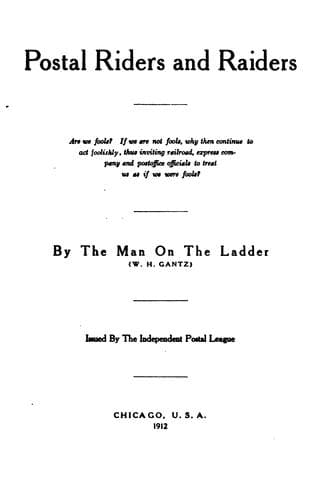
Postal service -- United States -- Second-class matter
In such and other minor ways, then, the fourth-class postmaster may be a
helpful instrument in the retention of power by the political party in
power--the party from which he has received appointment. So it is good
“practical” politics to keep such a party agent on the job. To that end,
then, the party in power--the administration--places the fourth-class
postmaster in the classified civil service, thus making his removal more
difficult, if not impossible, in case an opposing party should win out at
the polls and take charge of the government.
The foregoing is said, of course, on the presupposition that every reader
knows that a vast majority of the postmasters and other personnel of
the postal service today is of the political party in power. In saying
that the party from which these postmasters and other postal service
employes received their appointments has been and is using a civil
service classification largely, if not wholly, for partisan ends. I
say only--in fact have already said--that the Democratic party or any
other party would, if in national control, make similar use of the
civil classification. And such partisan manipulation of a merit service
classification will continue _so long as we fool people will stand for or
permit it_.
The chief “jokers” woven into most all civil service laws and executive
orders are these:
First: The law or “order” directing the application of a classification
of a service into certain grades, places those holding positions at the
time of the enforcement of such law or order, into the various grades
_without any examination as to their merit or efficiency_.
Second: Such laws and orders almost universally provide a promotion or
advancement credit for “experience,” and the only factor or element
recognized in the make-up of experience is _time_. The number of years an
employe has been on his job or in the service is his “experience.”
Third: Such civil service laws or orders always provide for
examinations--usually an “entrance” and “promotional”--and for
“examiners.” Seldom is anything said as to the qualifications of the
persons selected as examiners. Their selection is invariably left to a
“Civil Service Commission,” and the membership of such commission is as
invariably left to _partisan appointment_. There is usually a pretense
of making such commissions “non-partisan,” that is, one of three or two
of five of the appointed commissioners are to be of the minority party.
Nevertheless, they are _all_ appointed by the majority party--the party
in power.
Public-domain text, read in full here on John Shaqi.
Reviews
Reviews
No reviews yet
Be the first to share your thoughts on this work.
Elsewhere in the archive
Join the Discussion
Join the discussion
Sign in to leave a comment or review.
Sign InorCreate an account