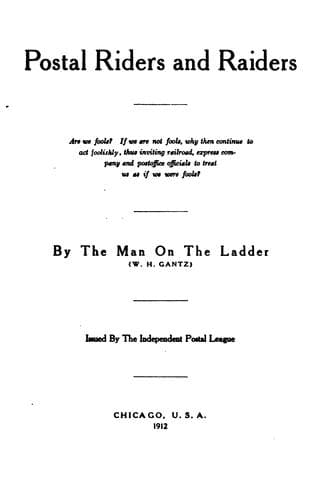
Postal service -- United States -- Second-class matter
You will observe that a considerable number of the clerical force are
doing something--are really trying to work. You will also discover before
going far that a number of employes are industriously engaged in talking.
The smiles and quiet laughter which embellish their conversation may lead
you to believe that they are talking about some of the humorous incidents
and features of the postal service. Do not, however, be hasty in arriving
at such conclusion. If you get near enough to hear an occasional word,
you may discover that their conversation is evidently about something
which a humoresque writer has described as “the recently distant
elsewhere,” and not about the department service at all. It may be about
some feature or phase of Washington’s social flux or about some social
function which is to stake a temporary claim in the circle in which the
talkers circulate. In short, you will discover that the conversation is
but commercially pasteurized small-talk and not business.
Moving on, you will observe other little groups in animated conversation.
A glance at the anæmic appearance of some of the talkers will lead you
to the immediate and sound conclusion that the subject of conversation
cannot be weighty. Politics, even party politics, either practical or
progressive, you will readily see would be some sizes too large for them.
Getting within hearing range, you will learn that these industrious
servants of the people are discussing the telling points in some prize
fight “pulled off” the night before or of the ball game which some one or
more of the coterie had seen the day before. Maybe some one of the group
is turning loose his stem-winding, automatic bloviate ejector in telling
his interested auditors about what a “ripping time” he had with Rose at
some dance or other party last night. What you hear will be sufficient to
convince you that these “classified civil service employes” must put in
considerable time in mental and physical exertion to work out of their
systems the lessons they were taught at mother’s knee, and much more of
their time trying to keep several laps behind their jobs. You will also
see that some of the service men are workers--real _workers_--who earn
more than the salaries paid them. So, too, are there many of them whose
industry should make a more or less conspicuous service trench into four
or five dollars a day. But when you get outside or get home, you will
remember having seen numerous supervising and directing heads and many
clerks who appeared to be actually tiring themselves out in exertions to
keep away from work.
Yes, I repeat, the Postoffice Department carries upon its payrolls too
many non-producers of service values--too many mere payroll-raiders on
the postal revenues. Putting all these into graded classified service and
under the protection of a “joker”-ridden law will not improve the actual
service--will not stop the raid of which I have been writing.
Public-domain text, read in full here on John Shaqi.
Reviews
Reviews
No reviews yet
Be the first to share your thoughts on this work.
Elsewhere in the archive
Join the Discussion
Join the discussion
Sign in to leave a comment or review.
Sign InorCreate an account