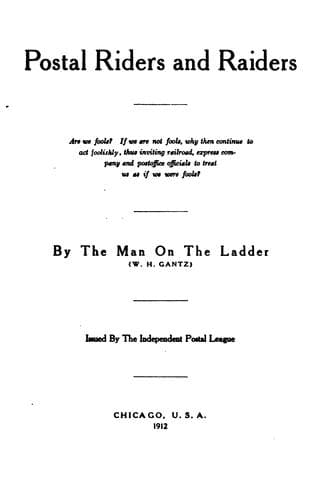
Postal service -- United States -- Second-class matter
Let’s see. A farmer may send a jar of butter, box of eggs, crate of
fruit or vegetables, etc., to the village storekeeper and get his pay
for the consignment, “in trade” usually. By writing the storekeeper an
order, postal card or letter, the farmer may get on the next round of the
carrier what he desires. That is, he will get what he has asked for if
the storekeeper has it in stock. The farmer, or the farmer’s wife, may
do the same thing in the event that the consignment of their products,
presuming that the “regulations” will permit the carrier to handle
perishable goods, goes no farther away than the county seat or other
town or city from which the rural route starts. They can also send such
parcels to any railroad station on the route for shipment to any more
distant point. In such case, however, the farmer must pay an express
carriage charge from the local railroad station to the destination of his
shipment.
But enough of this local application of the proposed “test” regulations.
It will readily be seen that if the farmer or villager on a selected test
route desires to send a parcel, not above the regulation weight--whatever
that may be--to any point not on the same route, he will have an express
charge to pay--whatever that charge may be. And if he orders something,
inside the regulation weight, from some factory or city not on his
carrier’s route, he must also pay an express charge for its carriage to
his local railroad station. If he wants the article or goods delivered
at his home by the rural carrier, he must pay an additional charge--the
postal carriage charge, whatever that may be.
As a “test” of the service value of a parcels post, could anything be
more absurd? If so, it would be difficult to frame it up. Such a “test,”
however, will still leave the raiding express companies in position
to hold up the selected “home circle,” rural-route residents on all
shipments, which go to or come from any city or point outside the home
circle--and that is about what, if not just what, the proposed “test” is
designed or intended to do, or so it appears from the ladder top.
In this connection it should be noted that the rural-route delivery
enactment, or the department regulations under which it was to be
applied, carried an express protecting “joker.” If not, why was the rural
route carrier required to furnish a cart or other carrying vehicle of
only twenty-five pounds capacity? Was it valid for ulterior reasons which
named so small a weight? Would it have cost the government any more money
for rural carrier service if a maximum weight of 500, or even of 1,000
pounds, had been named for the carrying vehicle?
The reader may answer. To The Man on the Ladder, though, that 25-pound
requirement looks to be of doubtful mail-service value, if, indeed, not
suspiciously queer.
Public-domain text, read in full here on John Shaqi.
Reviews
Reviews
No reviews yet
Be the first to share your thoughts on this work.
Elsewhere in the archive
Join the Discussion
Join the discussion
Sign in to leave a comment or review.
Sign InorCreate an account